A 4B open model, RL post-trained, out-scored GPT-5.6 Sol on agentic search at 1/94th the inference cost
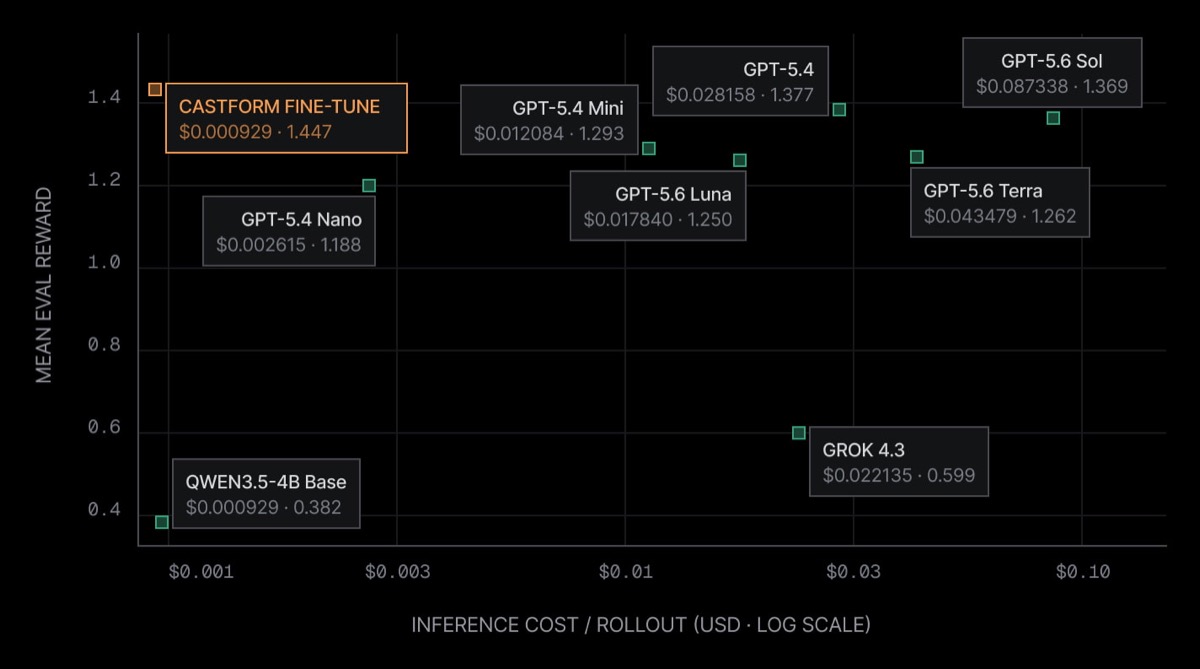
Neon and Castform published a cost-versus-quality chart on August 5, 2026: a post-trained Qwen3.5-4B hits 1.447 mean eval reward at $0.000929 per rollout, against GPT-5.6 Sol's 1.369 at $0.087338. The number is real and the method is reproducible — but the y-axis is the reward function they designed, and the same chart quietly makes a much cheaper argument they didn't make.
Neon and Castform published joint results on August 5, 2026 for an agentic-search agent built on a 4-billion-parameter open model. (Source: Neon blog, 2026-08-05)
Key facts:
- The base model is Qwen3.5-4B. Before post-training it scores 0.382 mean eval reward; after Castform’s RL run it scores 1.447.
- GPT-5.6 Sol scores 1.369 on the same eval.
- Inference cost per rollout is $0.000929 for the 4B model and $0.087338 for GPT-5.6 Sol — a 94x gap, with the small model slightly ahead on reward.
- A typical multi-turn agentic search request against gpt-5.6-sol takes over 10 seconds and costs about $0.03 end to end, per Neon’s own framing of the problem.
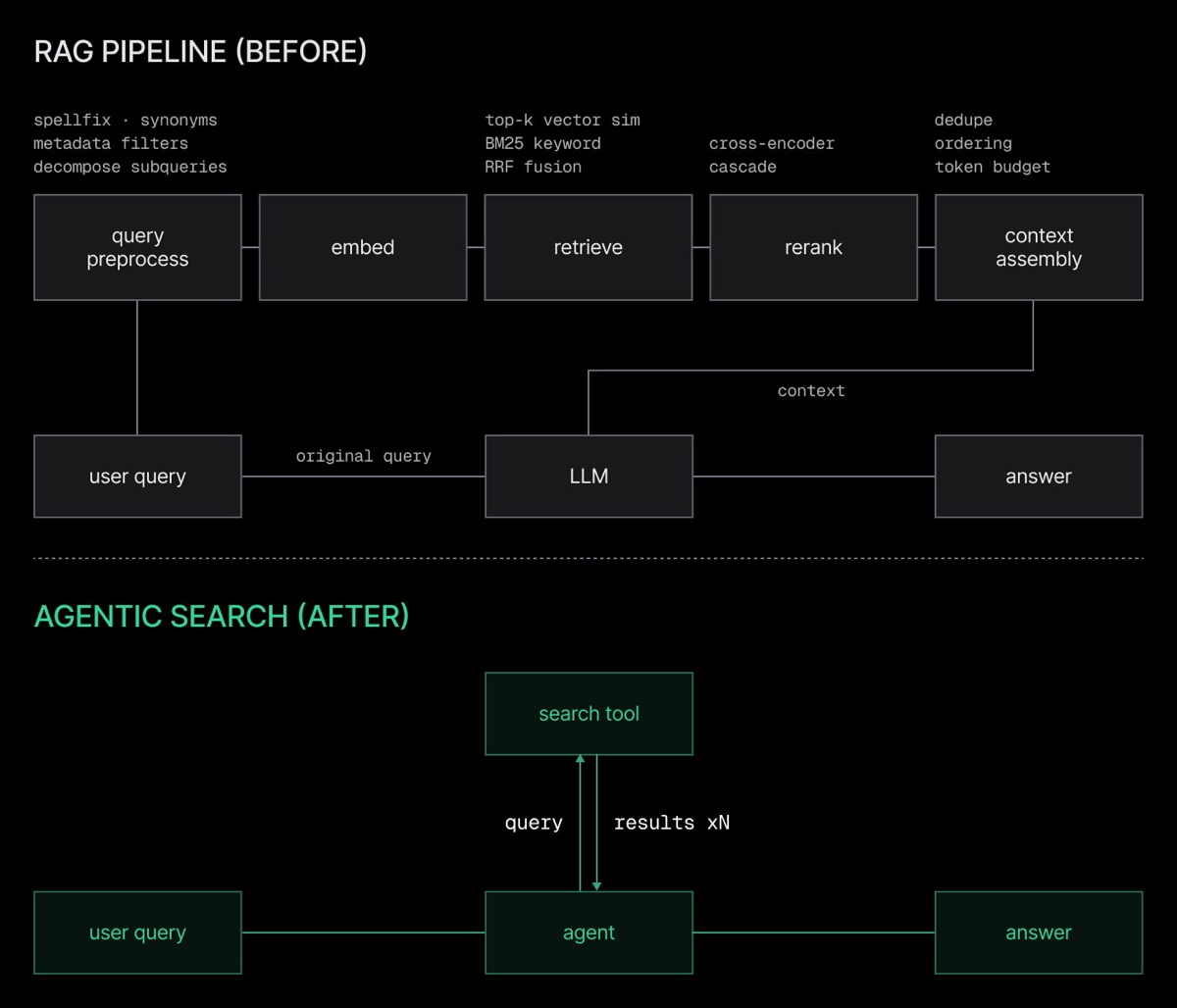
- The search tool is hybrid:
lakebase_text(BM25) andlakebase_vectorrun in parallel over Postgres on Neon and are merged with reciprocal rank fusion. - The reward function is a sum of three checkable parts — did the agent retrieve the right source, cite the right chunk, and land on the right answer.
- Castform’s separate technical write-up reports 0.46 ground-truth match versus GPT-5.2’s 0.34 on FinDER, a financial Q&A set over 10-K filings, with pass@8 improving about 63% during training. It was trained with DPPO and rolled out on SGLang. (Source: Castform blog, 2026)
What this means if you’re building agentic retrieval
1. Read the y-axis before you read the ranking. “Mean eval reward” is the reward function Castform wrote — retrieval plus citation plus correctness. A model trained by RL to maximise that reward topping that reward’s chart is the expected outcome, not an independent win. The honest claim is narrower than the headline and still useful: on one corpus, with one reward you define, a 4B model can be pushed past a frontier model. Nobody outside Neon and Castform has reproduced this, and the two posts measure different things — the chart above is unlabelled as to corpus, while the FinDER numbers come from Castform’s own separate post.
2. The cheap argument on that chart is the one they didn’t make. Look at GPT-5.4 Nano: 1.188 reward at $0.002615 per rollout. That is 33x cheaper than Sol for about 87% of Sol’s reward, and it costs you one line of config. RL post-training is a project — corpus prep, reward design, a training run, then serving your own weights. If your agentic search loop is currently on a frontier model because nobody tried anything else, try the cheap model first and measure. Post-training is the answer when the cheap model plateaus below your bar, not before.
3. What genuinely transfers is the reward shape. Retrieval + citation + correctness is gradeable without human labels the moment you have documents with known answers, which is why Castform can synthesise question-answer pairs straight out of an existing corpus. That trick is independent of their platform. If you have internal docs and a search tool, you already have the two hard ingredients most teams claim they lack.
4. Costs quoted are inference only. The $0.000929 figure does not include the RL run, the data-prep work, or the cost of serving a 4B model yourself at your traffic. Grok 4.3’s point on the same chart — 0.599 reward at $0.022135 — is a reminder that a bigger model is not automatically better at this task either.
Sources: Neon, 2026-08-05 · Castform, “rag not lag” · Castform beta launch
Related: Build a document extraction pipeline with Qwen3-VL · How to run NuExtract 3 locally · Qwen 3.6 for local coding
Source: Neon