Claude's text watermark is SynthID-Text — and it barely marks code
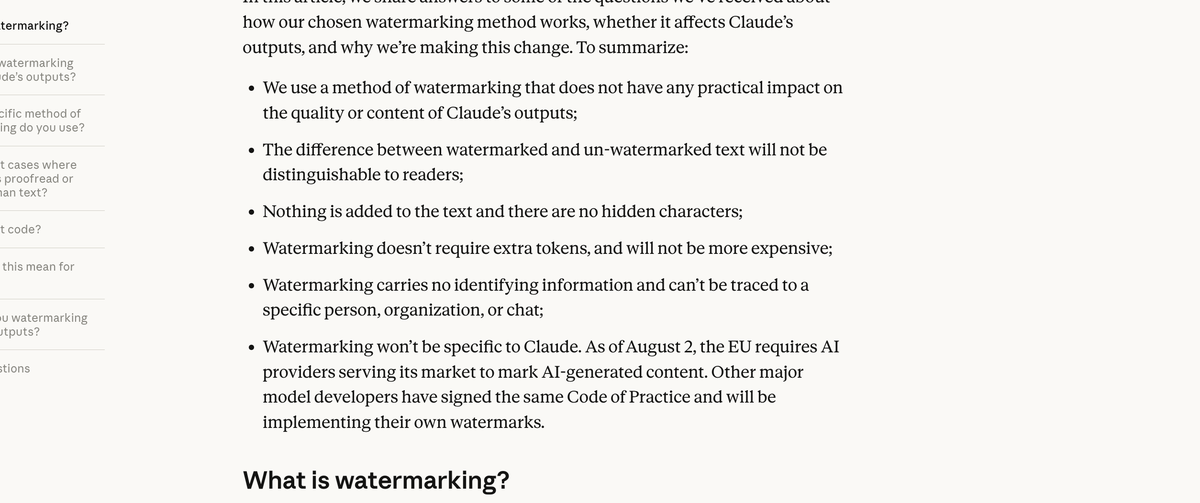
Anthropic published the Claude text-watermark FAQ on August 14, 2026. The method is a version of Google DeepMind's SynthID-Text. It adds no tokens, no hidden characters, and no user identity. Models launched before August 2 sit in an EU transition period. There is no public detector API yet.
Anthropic published “How Claude’s text watermark works” on August 14, 2026. Future Claude models will write text that carries a statistical watermark. The stated reason is the EU AI Act. As of August 2, 2026, providers serving the EU market must mark AI-generated content. Anthropic is applying the mark globally because it says it does not yet have a durable way to scope it by region. (Source: Anthropic announcement, 2026-08-14)
Key facts:
- The method is a version of SynthID-Text, the Google DeepMind scheme published in Nature in 2024. It only changes the source of randomness when the model picks among low-stakes next words. (Source: Anthropic; Dathathri et al., Nature 634, 818–823, 2024)
- Nothing is inserted into the text. There are no hidden characters. The watermark does not add tokens, does not change the list price, and Anthropic says the speed impact is negligible.
- It carries no user, org, or chat identity. A hit only answers: “What is the likelihood this was partly written by Claude?”
- Models launched before August 2, 2026 are not in the first wave. Anthropic says the EU law gives those models a transition period, and backfill “will be rolled out over the coming months.”
- There is no public detector today. Anthropic says it “will soon be offering a watermark detection API” and is still working out the details.
What this means if you’re building with Claude
1. Do not treat today’s Opus 5 / Fable 5 / Sonnet 5 traffic as watermarked. Those models launched before August 2. Anthropic has not named a post-August-2 Claude model that already ships the mark. The page is titled around future models plus a months-long backfill. If you need a compliance flag this week, this FAQ is not it.
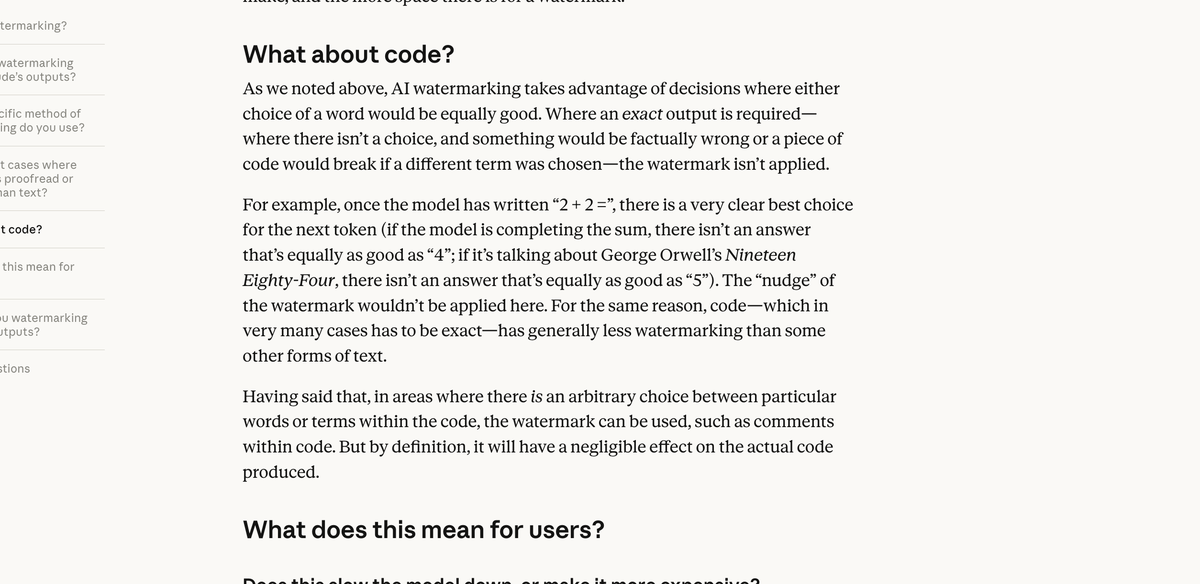
2. Code and agent diffs are the least marked surface. The watermark only fires where two tokens are equally good. Exact answers and tokens that would break a program are skipped. Anthropic says code “has generally less watermarking than some other forms of text,” and that comments can carry it, “but by definition, it will have a negligible effect on the actual code produced.” A Claude Code patch is a weak signal. A README, PR description, or translated spec is a strong one.
3. You cannot build a detector against this key yet. Anthropic’s detector API is “soon.” Third-party classifiers such as Pangram do not have Anthropic’s key; they look for style tells. Those are a different method. A “Claude watermark checker” product that claims to work today is not using the official channel.
4. Files are C2PA metadata, not a text watermark. For .png, .jpg, and .svg, Claude will attach a cryptographically signed content credential that says the file was made or processed with Claude. Anthropic will provide a drop-to-check tool. The pixels do not change. Strip the metadata and the label is gone. That is the opposite of the text scheme.
5. This is not the June 30 Claude Code Unicode marking. That was a hidden system-prompt signal on custom ANTHROPIC_BASE_URL values, removed in v2.1.197. Today’s scheme is a sampler change for EU marking.
A watermark cannot tell “Claude wrote this” from “Claude heavily edited this.” Light edits probably survive. A full rewrite does not. Translations are fully marked. Anthropic says it signed the EU Code of Practice with “around 190” other parties in July 2026; I did not recount the list.
Sources: Anthropic — How Claude’s text watermark works (2026-08-14) · SynthID-Text paper · Forbes report (2026-08-13/16) · Anthropic Help Center article
Related: How to switch to Claude Opus 5 · Claude Code Unicode marking · Claude Code as a daily driver
Source: Anthropic official announcement