FLUX 3 is here — but the part you can actually use isn't the image model
Black Forest Labs announced FLUX 3 on July 23, 2026: one multimodal network doing image, video, audio and robot action. Only FLUX 3 Video shipped, gated to selected partners. No pricing, no public API, and FLUX 3 Image and the open-weight FLUX 3 Dev are both still 'coming'. Here's what's real today.
Black Forest Labs announced FLUX 3 on July 23, 2026 — a single network that generates image, video, audio and robot action instead of a family of separate models. (Source: Black Forest Labs, 2026-07-23) For a lab whose previous releases were the default open-weight image models, that’s a big pivot. The catch: almost none of it is available yet.
Key facts:
- Announced July 23, 2026. Only FLUX 3 Video shipped, as gated early access via API and private weights to selected partners.
- FLUX 3 Image has not launched. BFL says “in the coming weeks.”
- No pricing has been announced — no per-generation cost, no tier, no public API.
- Video: up to 20 seconds, with audio. Evaluation samples were shown at 720p.
- FLUX 3 Dev, the open-weight multimodal backbone, is confirmed for later in 2026 — no date.
- Parameter counts are not disclosed.
The architecture is the actual news
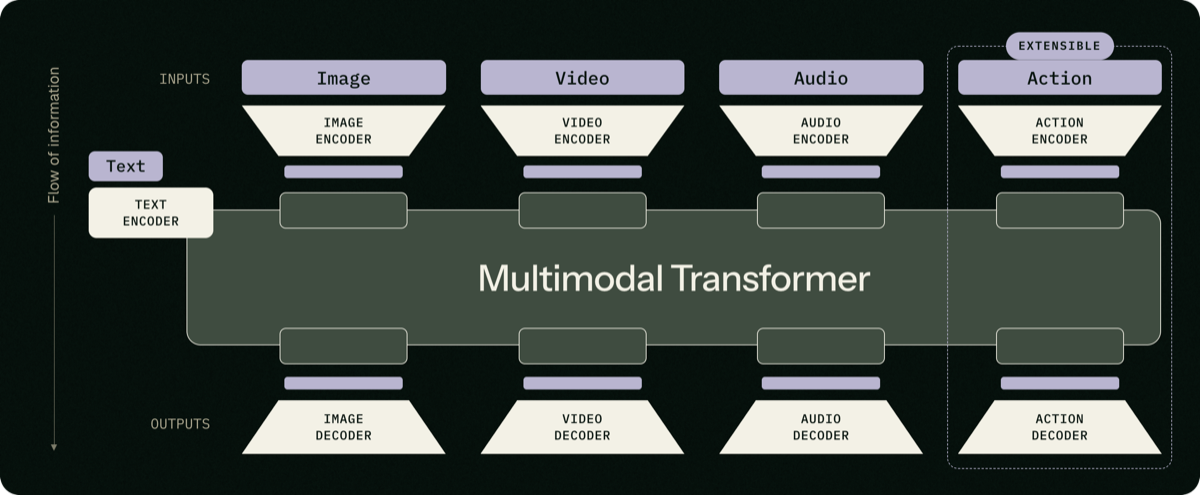
FLUX 3 routes every modality through one multimodal transformer, with per-modality encoders and decoders hanging off it — and an explicitly extensible slot for action.
BFL’s claim is that its training method — Self-Flow — makes generation and understanding improve together rather than trading off. Their numbers, against a flow-matching baseline normalized to 100:
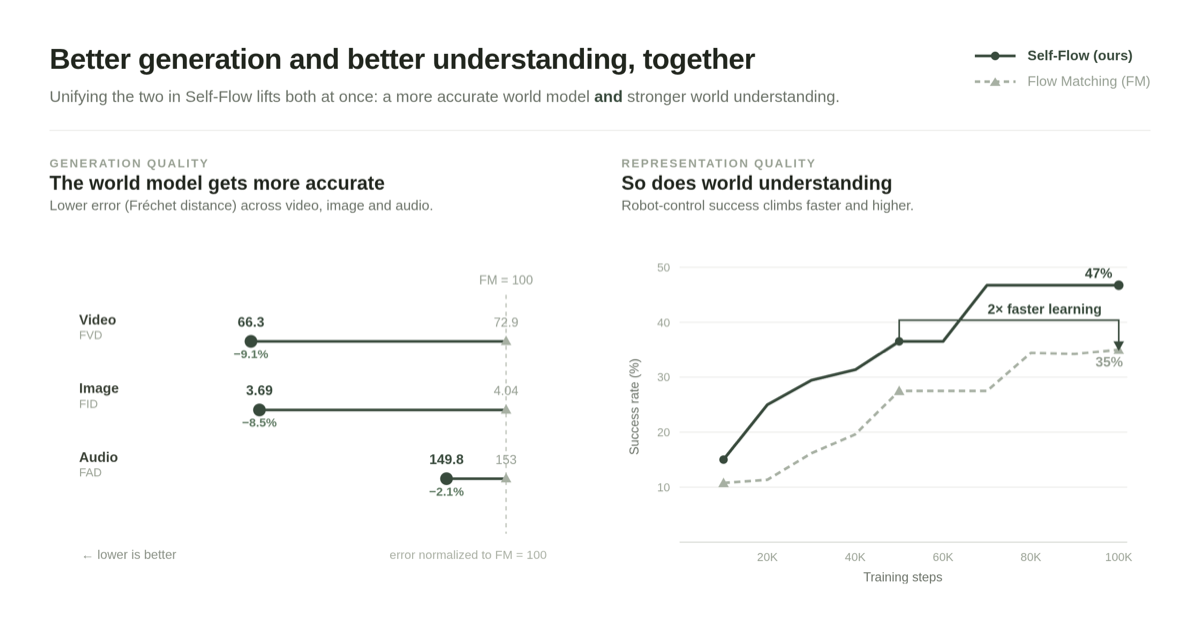
- Video FVD: 66.3 vs 72.9 — a 9.1% error reduction.
- Image FID: 3.69 vs 4.04 — 8.5% lower.
- Audio FAD: 149.8 vs 153 — 2.1% lower.
- Robot-control success: 47% vs 35%, which BFL describes as 2× faster learning.
These are BFL’s own internal comparisons against its own baseline, not a third-party eval.
The preference numbers, with the caveat BFL itself prints
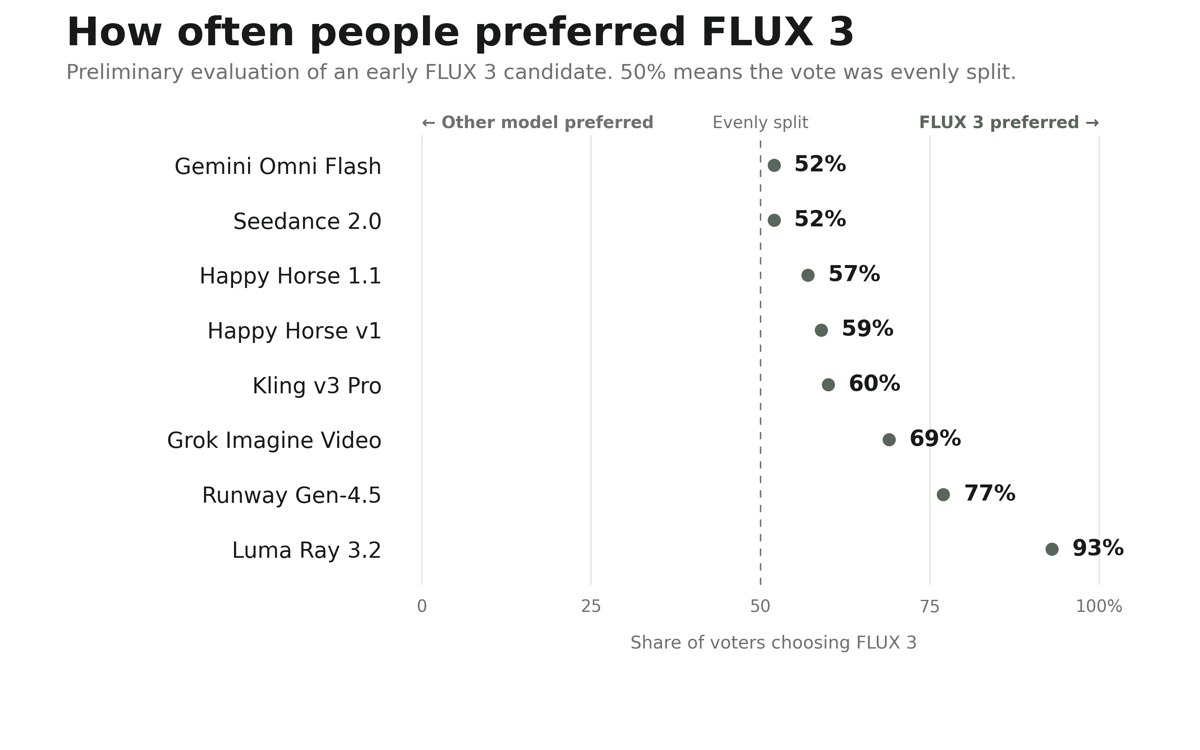
FLUX 3 Video wins most matchups — 93% vs Luma Ray 3.2, 77% vs Runway Gen-4.5, 69% vs Grok Imagine Video, 60% vs Kling v3 Pro. But the two closest competitors are effectively ties: 52% vs Seedance 2.0 and 52% vs Gemini Omni Flash — a coin flip. BFL labels the whole chart “preliminary evaluation of an early FLUX 3 candidate,” which is unusually honest and should be read literally.
What this means if you’re building with FLUX
Nothing changes in your pipeline this week. If you generate images through FLUX today, FLUX 3 Image isn’t out and has no announced price — you can’t plan a migration against it. If you need video generation now, the shipped options remain the ones on that chart, and two of them are statistically tied with FLUX 3 anyway.
The thing worth tracking is FLUX 3 Dev. BFL built its position on open weights, and an open-weight multimodal backbone that does image, video and audio in one network would be a genuinely new local-inference target — nothing in that class runs on consumer hardware today. Until parameter counts land, assume it won’t fit on your GPU. If local image generation is what you actually need right now, a 4B ternary diffusion model like Bonsai Image 4B is the realistic end of that spectrum.
Apply for early access only if video is your product. Access requires an application at bfl.ai, and gated partner programs with no published pricing are a poor foundation for anything with a launch date.
Sources
- FLUX 3 announcement (Black Forest Labs, 2026-07-23)
- Black Forest Labs launches FLUX 3 capable of generating images and 20-second video with audio — but in limited release to start (VentureBeat)
- FLUX 3: Black Forest Labs’ Multimodal Video, Audio and Image Model (ComfyUI Wiki, 2026-07-23)
Source: Black Forest Labs