OpenAI cuts GPT-5.6 Luna 80% and Terra 20%, replaces Priority Processing with Fast mode
Starting July 30, 2026, GPT-5.6 Luna costs $0.20 input / $1.20 output per 1M tokens (down from $1.00 / $6.00) and Terra costs $2.00 / $12.00 (down from $2.50 / $15.00). Sol pricing is unchanged, but Priority Processing is now Fast mode: up to 2.5x faster at 2x the price. Here's what the new numbers do to a planner/executor agent bill.
OpenAI cut API prices for two of its three GPT-5.6 models on July 30, 2026. (Source: OpenAI official blog, 2026-07-30) GPT-5.6 Luna is 80% cheaper. GPT-5.6 Terra is 20% cheaper. Sol is unchanged, but its speed tier was renamed and repriced.
Key facts:
- Luna is now $0.20 per 1M input tokens and $1.20 per 1M output tokens. Cached input is $0.02. (Source: OpenAI model docs,
gpt-5.6-luna, retrieved 2026-07-31) - Terra is now $2.00 input / $12.00 output per 1M tokens. Cached input is $0.20. (Source: OpenAI model docs,
gpt-5.6-terra) - Sol is unchanged at $5.00 input / $30.00 output per 1M tokens, cached input $0.50.
- Fast mode replaces Priority Processing in the API. For Sol it is “up to 2.5× faster speeds than Standard processing at twice the price, with no change in intelligence.” Requests already tagged
priorityautomatically use Fast mode. (Source: OpenAI official blog, 2026-07-30) - All three models share a 1,050,000-token context window and 128,000 max output tokens. Prompts over 272K input tokens are billed at 2× input and 1.5× output for the full request; cache writes bill at 1.25× the uncached input rate. (Source: OpenAI model docs, retrieved 2026-07-31)
- The lower Luna and Terra prices also mean those models “consume fewer credits” against Codex and ChatGPT Work subscription quotas. Subscription prices and quota budgets are unchanged.
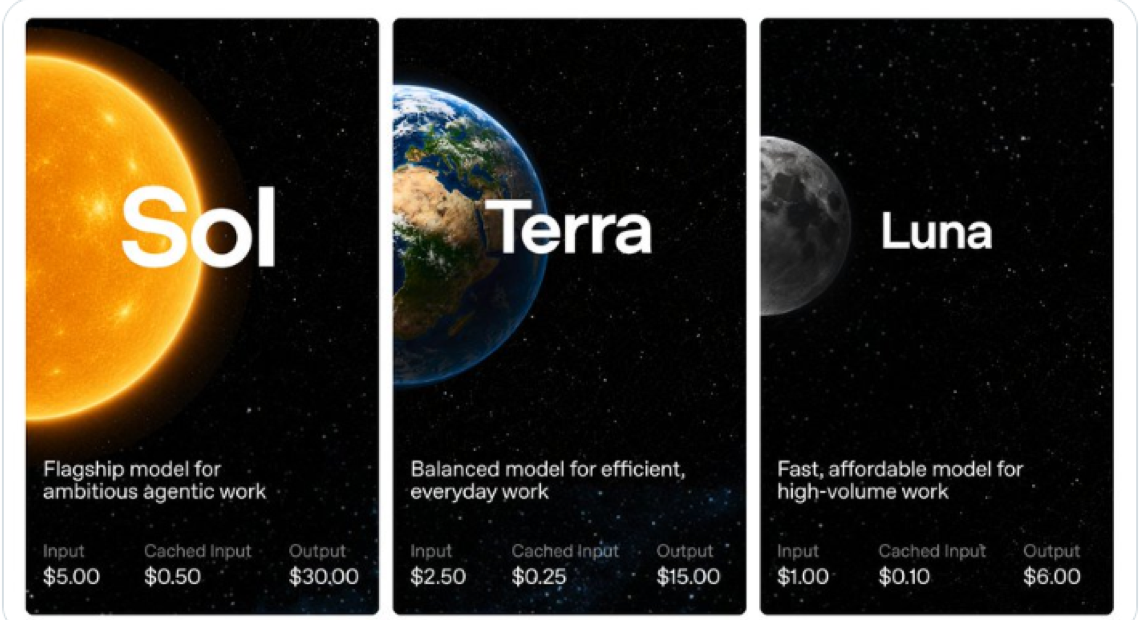 OpenAI’s own launch card from the GPT-5.6 announcement, showing the original prices: Sol $5.00/$0.50/$30.00, Terra $2.50/$0.25/$15.00, Luna $1.00/$0.10/$6.00 per 1M tokens. As of July 30, Terra and Luna are the two columns that moved. (Card image: OpenAI, published 2026-06-27; current prices verified against OpenAI’s model docs)
The before/after table
| Model | Input (old → new) | Cached input (old → new) | Output (old → new) |
|---|---|---|---|
| Sol | $5.00 → $5.00 | $0.50 → $0.50 | $30.00 → $30.00 |
| Terra | $2.50 → $2.00 | $0.25 → $0.20 | $15.00 → $12.00 |
| Luna | $1.00 → $0.20 | $0.10 → $0.02 | $6.00 → $1.20 |
All figures are USD per 1M tokens. Old prices are from OpenAI’s June 27 launch card; new prices are from the model reference pages, checked on 2026-07-31.
What this means if you’re building with GPT-5.6
The planner/executor split just got much cheaper on the executor side. OpenAI spells out the pattern in its own post: “A coding workflow, for example, might use Sol to resolve uncertainty and define the plan, then use Luna to implement well-specified changes, write and run tests, and evaluate the results.” That architecture was already common. What changed is the arithmetic. A loop that burns 2M output tokens a day on the executor now costs $2.40 instead of $12.00.
Output tokens are where the cut lands hardest. Luna’s output price fell from $6.00 to $1.20 — a 5× drop. Agent loops are output-heavy (reasoning tokens, tool-call arguments, retries), so the realized savings for an agent workload are usually closer to the output ratio than to the input ratio. If you budgeted an agent product against Luna’s old $6.00 output, re-run that model before you re-price anything.
Check every priority flag in your codebase this week. Priority Processing is gone as a product name, and priority-tagged requests now silently route to Fast mode. For Sol, Fast mode is 2× the standard price. If you set priority broadly once and forgot about it, your Sol spend just changed shape — same intelligence, up to 2.5× faster, double the bill. This is the one line of the announcement that can surprise you on an invoice.
Cached input is now the cheapest thing in the lineup. Luna cached input at $0.02 per 1M tokens is a 10× discount off its own input rate. If you have a long, stable system prompt or a fixed tool schema in front of every call, prompt caching is worth more than it was yesterday in relative terms. Note the flip side OpenAI documents: cache writes bill at 1.25× the uncached rate, so caching only pays off with real reuse.
Two claims worth treating as marketing until you eval them yourself. OpenAI says Luna delivers “performance comparable to models that were frontier-class a year ago at roughly 6 cents on the dollar per task, and at nearly nine times the speed,” and that on Agents’ Last Exam “Luna outperforms Fable 5 at an estimated cost per task nearly 99% lower.” Both are OpenAI’s own framing with an “estimated” cost basis and no published methodology in the post. The pricing is a fact; the head-to-head is a vendor claim.
If you are migrating, our guide to switching to GPT-5.6 covers the exact model IDs (gpt-5.6-sol, gpt-5.6-terra, gpt-5.6-luna), the max and ultra reasoning-effort settings, and the one real breaking change from GPT-5.5 — prompt caching moved to prompt_cache_options.ttl. If the cheaper Luna tier has you rethinking which model runs your agent’s inner loop, the token-side savings in how to reduce Claude Code token overhead apply to any provider.
Sources
Source: OpenAI Official Blog