GPT-6 Astra reaches OpenAI's Critical cyber threshold — but most coding teams cannot switch to it yet
OpenAI introduced GPT-6 Astra on September 3, 2026. Astra is the first broadly deployed OpenAI model judged Critical for cybersecurity capability, but it is rolling out only to a limited set of organizations and every external tool-using deployment has misalignment monitoring.
OpenAI introduced GPT-6 Astra on September 3, 2026. The important builder detail is availability: Astra is rolling out to a limited set of organizations and is not generally available yet. (Source: OpenAI ChatGPT Release Notes, 2026-09-03)
Key facts:
- GPT-6 Astra is OpenAI’s first broadly deployed model assessed at the Critical cybersecurity-capability threshold. (Source: GPT-6 Astra System Card, 2026-09-03)
- Astra is not generally available. OpenAI says broader availability is planned over the coming days, without publishing a date, API model ID, or price.
- All external Astra deployments that use tools receive misalignment monitoring. OpenAI says this adds significant compute cost. (Source: GPT-6 Astra System Card, 2026-09-03)
- On OpenAI’s indirect prompt-injection evaluation, robustness rose from 96.23% to 99.79%. This is an OpenAI evaluation, not an independent production measurement. (Source: GPT-6 Astra System Card, 2026-09-03)

What this means if you’re building with coding agents
Do not schedule a migration yet. A new model name is not a deployable upgrade while OpenAI has not published general access, an API identifier, or pricing. Keep production traffic pinned to the explicit model IDs you already operate. That avoids accidentally treating a limited rollout as an API contract.
Treat the monitoring layer as part of the product, not a footnote. OpenAI says Astra’s external tool-using inference is monitored for potential misalignment and may be paused or stopped for review. For a coding agent, that means a long-running job may have a new operational failure mode: a task can require human intervention even when the model itself is working. Build resumable jobs, durable checkpoints, and clear audit logs before using any preview agent with repo or browser access.
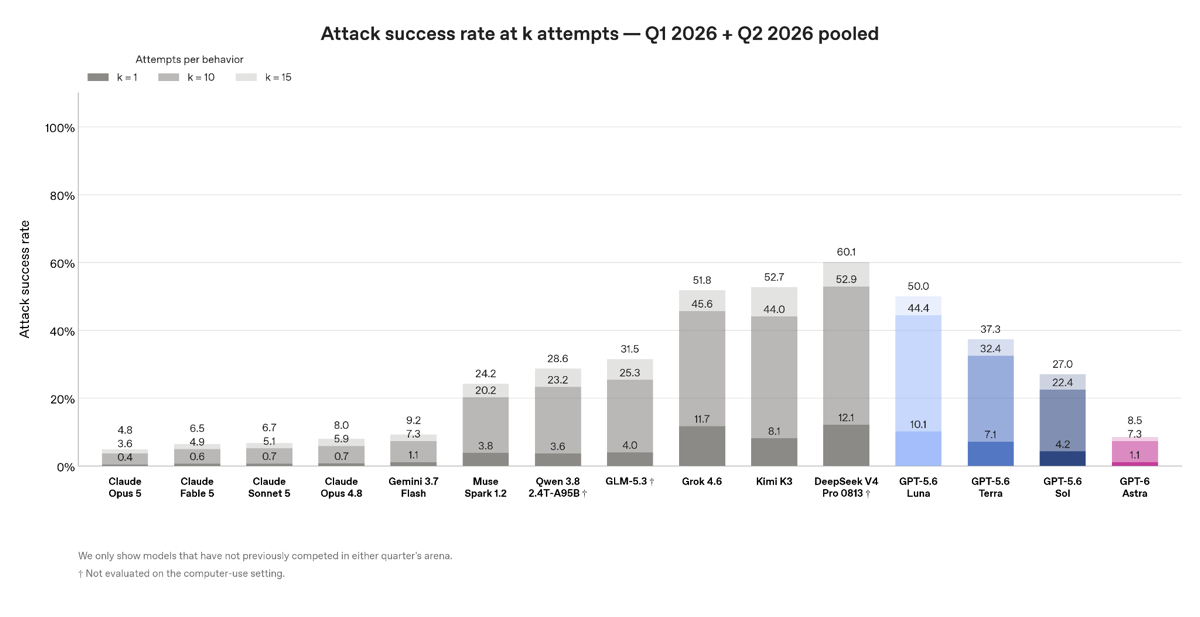
Keep defense in your own workflow. Better model-side prompt-injection results do not remove the need for least-privilege credentials, review gates, and scoped tool permissions. The 99.79% figure is OpenAI’s average defender success rate per query on its curated test set; a single successful indirect injection can still matter if an agent can push code, read secrets, or purchase services. Use the guardrails in the Codex Security guide for repositories, and keep agent permissions narrower than the task’s blast radius.
OpenAI’s broader announcement frames Astra as a capability-and-safeguards release, not a general developer API launch. Its system card also says the model can be less monitorable than GPT-5.6 Sol under adversarial testing, even while OpenAI reports better overall alignment and safety behavior. That is a reason to evaluate the whole runtime—model, monitoring, tool scopes, and recovery path—rather than swapping a model string when access appears. (Source: OpenAI, “Path to Astra”, 2026-09-03)
Sources: OpenAI ChatGPT Release Notes (2026-09-03) · GPT-6 Astra System Card (2026-09-03) · OpenAI: Path to Astra (2026-09-03)
Related: How to use Codex Security · How to switch to GPT-5.6 · GPT-5.6 Cyber Daybreak Red
Source: OpenAI ChatGPT Release Notes