GPT-6 Sol and Luna ship: OpenAI cuts the API price 50%, but the migration has one cache trap
OpenAI released GPT-6 Sol and GPT-6 Luna on September 22, 2026. Sol costs $2/$10 per 1M tokens and Luna costs $0.10/$0.50, with a 1.05M-token context window. For API builders, the important limit is the 272K-token price boundary.
OpenAI released GPT-6 Sol (gpt-6-sol) and GPT-6 Luna (gpt-6-luna) on September 22, 2026. Both are now live in the Responses and Chat Completions APIs. Sol is the coding-and-agent tier; Luna is the high-volume tier. (Source: OpenAI announcement, 2026-09-22)
Key facts:
- GPT-6 Sol costs $2 input and $10 output per 1M tokens. Cached input costs $0.20.
- GPT-6 Luna costs $0.10 input and $0.50 output per 1M tokens. Cached input costs $0.01.
- Both models have a 1.05M-token context window and a 128K-token maximum output. (Source: OpenAI model catalog, retrieved 2026-09-23)
- The advertised standard rates apply to prompts up to 272K input tokens. Above that boundary, Sol is $4/$15 and Luna is $0.20/$0.75 for input/output. (Source: OpenAI pricing, retrieved 2026-09-23)
- Sol and Luna support
none,low,medium,high,xhigh, andmaxreasoning effort.
OpenAI calls the change a 50% reduction versus GPT-5.6’s promotional Sol and Luna rates. The useful builder distinction is not the headline discount but workload shape: Sol is for demanding coding and agent workflows, while Luna is the cheaper choice for repeatable, latency- and cost-sensitive tasks. The official catalog also lists web search, file search, code interpreter, hosted shell, computer use, MCP, and tool search for Sol when using the Responses API.
What this means if you’re building with GPT-6
1. Change the model ID first; do not assume your long-context bill halves. The September 22 changelog confirms the IDs and the two supported API families. A request with more than 272K input tokens crosses into a higher price column for the whole request. If an agent carries a large repository, tool transcript, or document bundle, measure its input length before treating Sol’s $2/$10 as its effective rate. (Source: OpenAI API changelog, 2026-09-22)
2. Keep the reusable prefix stable. Sol cached reads are $0.20 per 1M tokens, a 90% reduction from its standard input rate. Put stable instructions, tool definitions, and reference material before changing user state. OpenAI says GPT-6 supports cache-aware changes to reasoning effort and tool availability, but a cache discount only helps when your requests actually reuse context. Our existing GPT-5.6 switching guide covers the practical model-routing baseline to update.
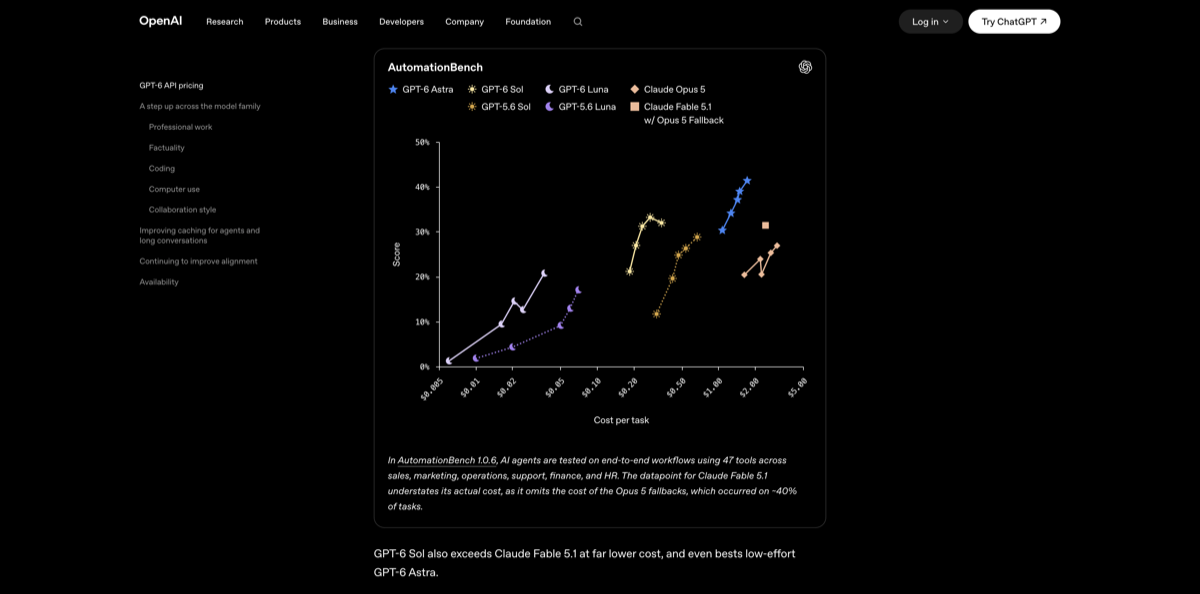
3. Treat OpenAI’s benchmark claims as vendor results. OpenAI reports that Sol reaches 68.8% on DeepSWE v1.1 at max effort, and Luna reaches 66.6%; the announcement’s charts combine different effort settings and cost-per-task assumptions. The relevant test is your own repository, tools, prompts, and review gate—not a chart alone.
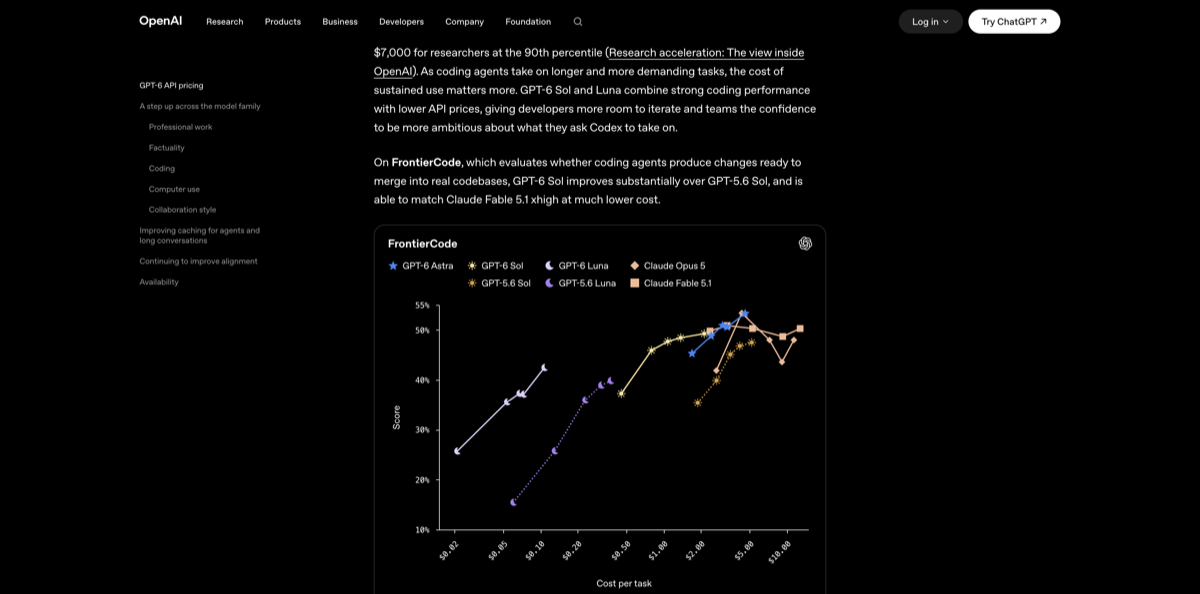
For autonomous coding agents, lower token price is not a reason to relax permissions. Keep the same least-privilege credentials, patch review, and scoped tool access described in our Codex Security guide. Cost efficiency lets an agent iterate more; it also increases the value of a correct review boundary.
Sources: OpenAI: Introducing GPT-6 Sol and Luna · OpenAI model catalog · OpenAI pricing · OpenAI API changelog
Related: How to switch to GPT-5.6 · How to use Codex Security · GPT-5.6 Sol gateway pricing
Source: OpenAI