Ideogram 4.0 ships open weights: the top open-weight image model, but commercial use needs a license
Ideogram released Ideogram 4.0 on June 3, 2026 as a 9.3B open-weight diffusion transformer — best-in-class text rendering, native 2K resolution, and the #1 spot among open-weight models on DesignArena. The catch for builders: the weights are non-commercial. Here's what shipped and what the license actually allows.
Ideogram released Ideogram 4.0 on June 3, 2026 as an open-weight text-to-image model — and on the DesignArena leaderboard it is the highest-ranked open-weight model, beaten only by closed models from OpenAI and Google. (Source: Ideogram GitHub, 2026-06-03) The catch builders need to read first: the published weights are non-commercial.
Key facts:
- The model has 9.3 billion parameters.
- It is a fully single-stream Diffusion Transformer (DiT) — text and image tokens run in one stream.
- The text encoder is a vision-language model, Qwen3-VL-8B-Instruct, not a text-only encoder.
- It supports any resolution from 256 to 2048px per side (native 2K).
- The released weights ship under an Ideogram 4 Non-Commercial license — commercial use requires a separate paid license. (Source: Ideogram GitHub, 2026-06-03)
- Weights are on Hugging Face in nf4 (CUDA) and fp8 (all hardware) variants, behind a license-acceptance gate.
- Ideogram’s own hosted API prices images at $0.03 (Turbo), $0.06 (Default), and $0.10 (Quality).

Where it actually ranks
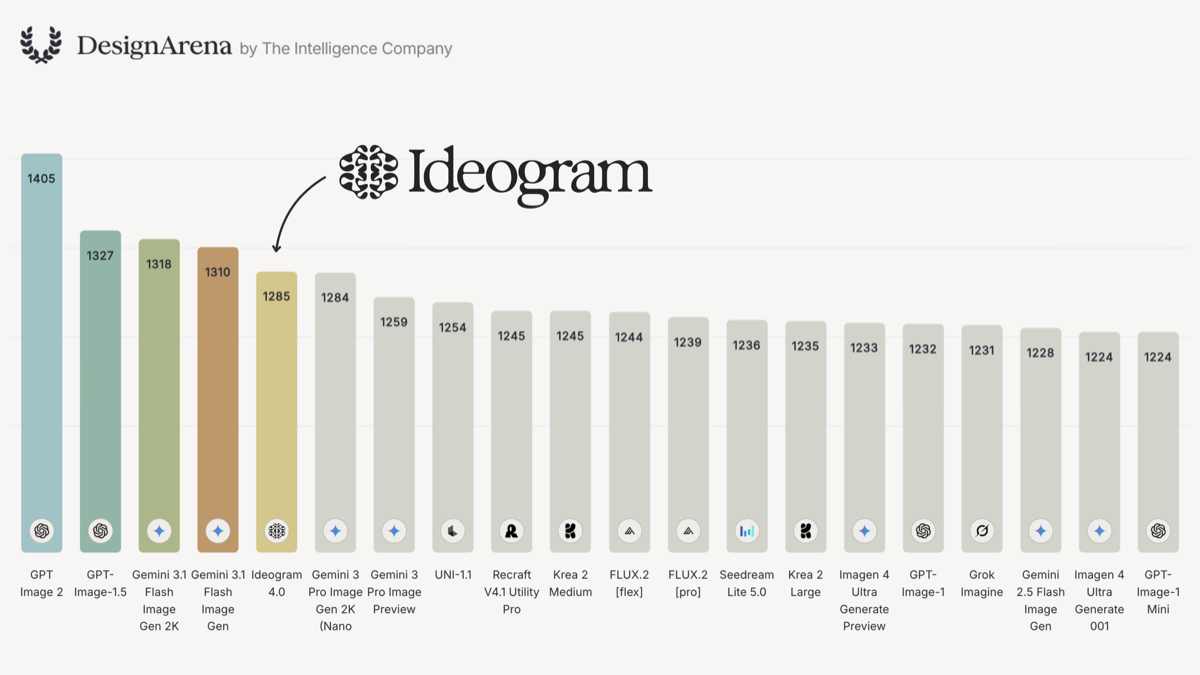
On DesignArena, Ideogram 4.0 scores 1285 Elo — fifth overall, but first among open-weight models. The four models above it are all closed: GPT Image 2 (1405), GPT-Image-1.5 (1327), and two Gemini 3.1 Flash Image variants (1318 / 1310). Every other open-weight image model — including Recraft, FLUX.2, Seedream, and Krea — sits below it. (Source: DesignArena via Ideogram, 2026-06-03)
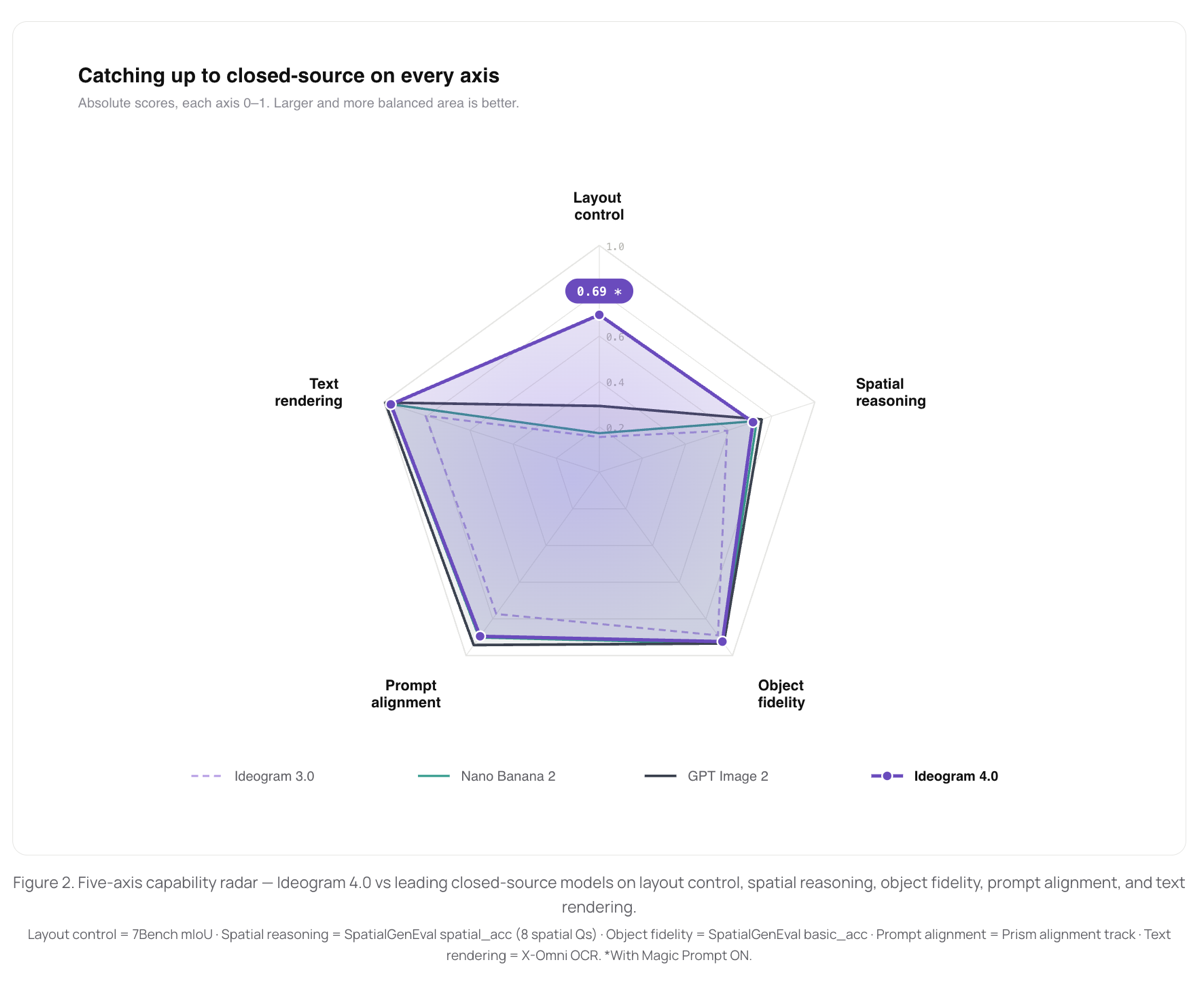
Ideogram’s own published radar puts its biggest gains in text rendering and layout control — the axes where open image models have historically been weakest, and the reason it leads on a design benchmark specifically.
What this means if you self-host image models
For builders, the weights-plus-license combination is the whole decision. The model runs in ComfyUI, fal, Replicate, and Krea, and the nf4/fp8 quants are small enough to serve on a single GPU — so for prototyping, internal tools, or personal projects, this is now the strongest open-weight option for logos, posters, and anything text-heavy. The Qwen3-VL text encoder also means it reads prompts more like a VLM than a CLIP-style encoder, which is part of why its prompt-following holds up.
But non-commercial means non-commercial. If you ship generated images in a product, sell them, or use them in client work, you need Ideogram’s paid license — or you stay on the hosted API at $0.03–$0.10 per image. That’s a different calculus from a truly permissive model like the Apache-2.0 Bonsai Image 4B you can run locally, which carries no commercial asterisk. Pick on license first, quality second: Ideogram wins on output, Bonsai wins on freedom.
Sources
- ideogram-oss/ideogram4 — Ideogram 4: Open image model at the forefront of design — Ideogram (GitHub), 2026-06-03
- Ideogram 4.0 drops as an open-weight model with native 2K resolution and improved text rendering — The Decoder, 2026-06-03
- ideogram-ai/ideogram-4-nf4 — Hugging Face model card, 2026-06-03
Source: Ideogram (GitHub)