Andrej Karpathy joins Anthropic — and the bet behind it is that pre-training isn't done
OpenAI co-founder and former Tesla AI director Andrej Karpathy announced on May 19, 2026 that he has joined Anthropic, working on pre-training research. Here is what builders should read into the move beyond the headline.
On the evening of May 19, 2026, Andrej Karpathy — OpenAI co-founder, former Tesla AI director, and one of the most-followed AI researchers on the internet — posted this:
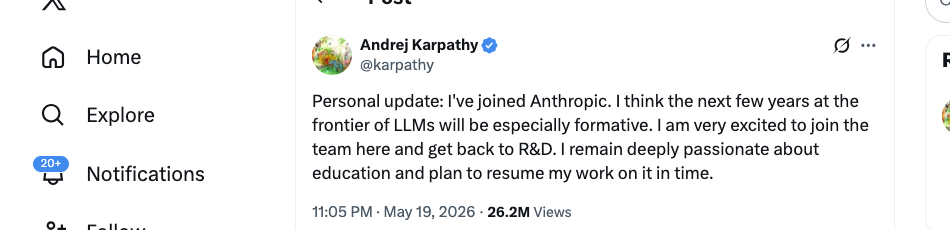
Per TechCrunch’s reporting, Karpathy started “this week” on Anthropic’s pre-training team, reporting to team lead Nick Joseph. An Anthropic spokesperson confirmed he will start a team focused on “using Claude to accelerate pre-training research” — i.e. using their existing model to make the next model’s training pipeline better.
The career arc
This is Karpathy’s fifth major chapter in AI:
| Year | Where | Role |
|---|---|---|
| 2015–2017 | OpenAI | Founding research scientist, deep learning + computer vision |
| 2017–2022 | Tesla | Director of AI — led Full Self-Driving and Autopilot |
| 2023–2024 | OpenAI | Returned for one year, left in early 2024 |
| 2024–2026 | Eureka Labs | His own startup, applying AI assistants to education |
| 2026– | Anthropic | Pre-training research |
What happens to Eureka Labs is unclear — TechCrunch notes it’s “not clear if the renowned researcher will continue with the startup.” Karpathy himself wrote: “I remain deeply passionate about education and plan to resume my work on it in time.”
What builders should actually read into this
Three signals matter beyond “famous person changed jobs”:
1. Pre-training isn’t done. The dominant narrative through 2024-2025 was that pre-training had hit a ceiling and the frontier was moving to post-training (RLHF, agent loops, tool use). Karpathy choosing pre-training — explicitly — is a vote against that consensus. If pre-training were really commodified, hiring him to lead a pre-training team would be a strange use of his time. Anthropic is betting the next jump in model quality comes from training-loop improvements, not just RL on top of fixed bases.
2. Anthropic is now the talent magnet, not OpenAI. Karpathy joining a competitor of the company he co-founded is the cleanest possible signal of where the talented researchers think the most interesting work is happening today. This is the same week Anthropic also announced security researcher Chris Rohlf joining — multiple high-profile hires inside one news cycle.
3. Claude is being used to train Claude. The spokesperson’s wording — “using Claude to accelerate pre-training research” — is the more important detail than which lab Karpathy picked. Anthropic is openly building a recursive feedback loop where today’s Claude shapes tomorrow’s Claude’s training data, training infrastructure, and architecture choices. This is how compounding starts.
What this changes for builders on Claude
In the short term, nothing changes for you. Karpathy’s work won’t ship in a Claude API release this quarter. But the medium-term implication is that Claude’s next major version (Opus 5, or whatever follows) is going to be trained differently — informed by an experienced researcher whose Tesla-era credentials include shipping production-grade AI under unforgiving real-world constraints. For anyone whose product depends on Claude Sonnet 4.6 / Opus 4.7 today (see also our Gemini 3.5 Flash vs Claude Haiku 4.5 comparison), this is a positive long-term signal about model quality continuity.
Sources
Source: TechCrunch