Kimi K3 open weights are live — 1.56 TB of MXFP4 shards, and 8× GB300 to serve them
Moonshot AI shipped the Kimi K3 weights on July 27, 2026, as promised. We pulled the Hugging Face file manifest: 96 safetensors shards, 1,560.9 GB total — not the ~594 GB some write-ups claimed. There is no BF16 variant; MXFP4 is the release format. vLLM's recipe says at least 8× GB300. Here's what that means if you were planning to self-host.
Moonshot AI published the Kimi K3 weights on Hugging Face on July 27, 2026 — the date it committed to when the model launched via API on July 16. Moonshot calls it “the world’s first open 3T-class model.” It is also, for almost everyone reading this, unrunnable on hardware you own.
Key facts:
- Total download: 1,560.9 GB across 96 safetensors shards. (Source: Hugging Face model repo manifest, queried 2026-07-28. Largest single shard: 17.0 GB.)
- The model is 2.8T total parameters, 104B activated per token. 896 experts, 16 selected per token, plus 2 shared experts.
- There is no BF16 checkpoint. The repo ships MXFP4 weights / MXFP8 activations only, produced by quantization-aware training from the SFT stage onward.
- Context window: 1,048,576 tokens. 93 layers, 69 KDA + 24 Gated MLA. Vision encoder is MoonViT-V2, 401M params.
- vLLM’s own recipe lists “at least 8× GB300” as the hardware floor, vLLM 0.26.0+, and recommends multi-node for real production traffic. (Source: vLLM recipes)
Correcting the download-size number
Several launch write-ups this weekend put the MXFP4 download at roughly 594 GB. That figure does not match the repository. Summing the size field over every file in the Hugging Face API manifest gives 1,560,998,984,390 bytes — 1,560.9 GB, or 1.42 TiB. That is what a naive 2.8T-parameter model at ~4 bits per weight should cost, plus scales, embeddings and the vision tower, so the manifest is the number to plan against. Budget storage and egress accordingly.
The benchmarks Moonshot is claiming
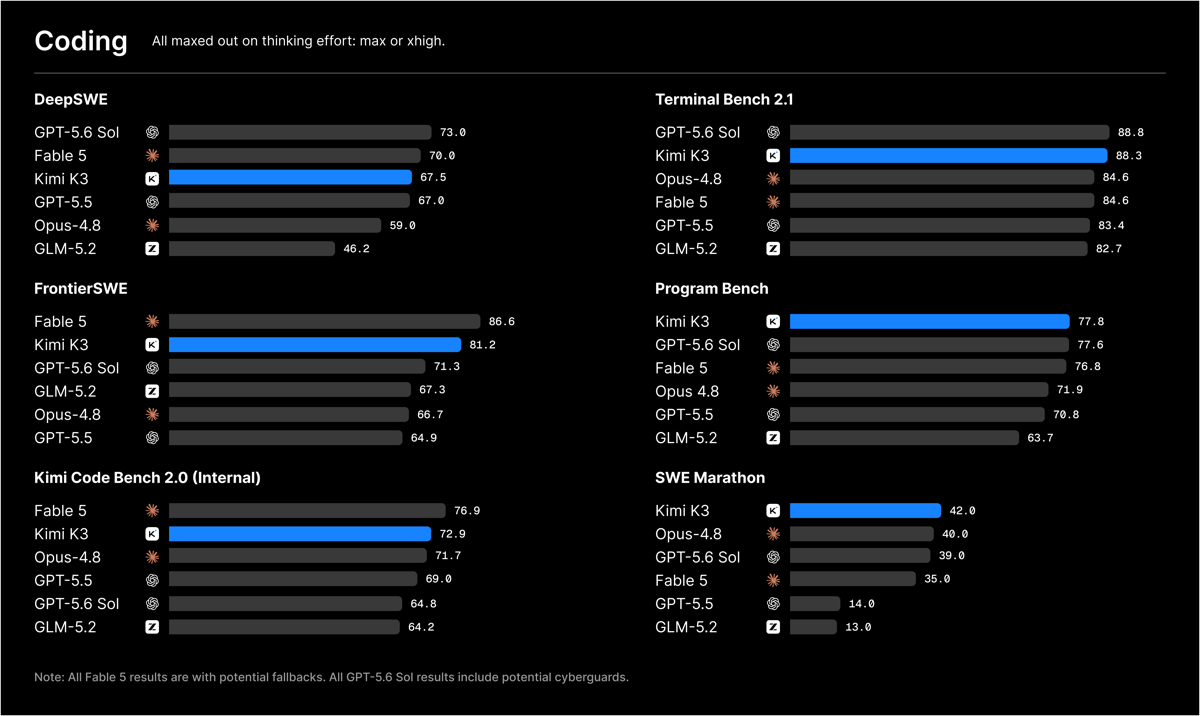
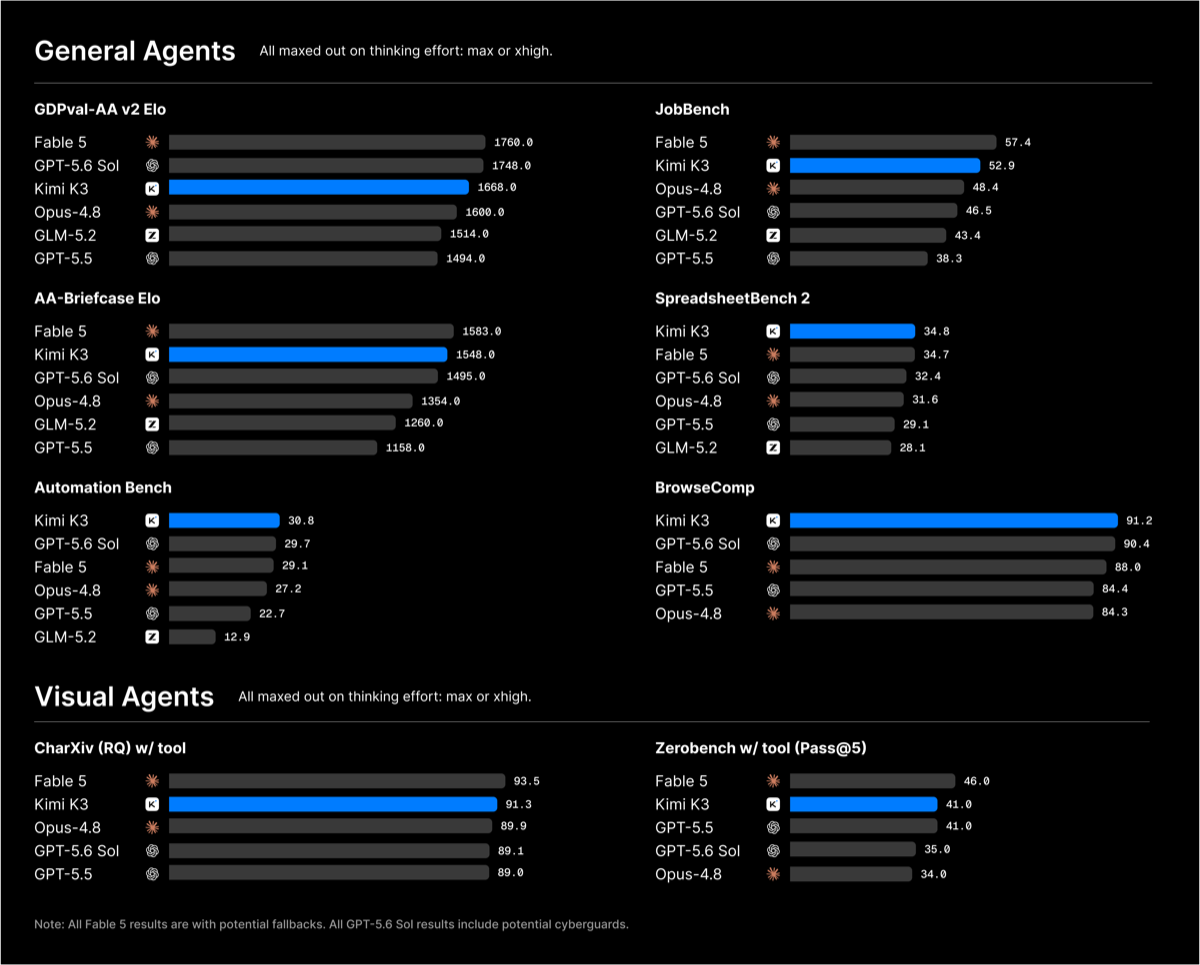
The single strongest claim is BrowseComp at 91.2, ahead of GPT-5.6 Sol (90.4) and Claude Fable 5 (88.0). Moonshot discloses that this uses context compaction triggered at 300K tokens; with the full 1M window and no context management, K3 scores 90.4. That footnote is unusually honest and worth reading before you cite the headline number.
The license is more permissive than the hardware
The Kimi K3 License is MIT-shaped: use, modify, distribute, sell, fine-tune, no restrictions — with two carve-outs. If you run a Model-as-a-Service business and your group revenue passes $20M over any consecutive 12 months, you need a separate agreement with Moonshot before commercial use. If your product exceeds 100M MAU or $20M monthly revenue, you must display “Kimi K3” in the UI. Internal use is exempt from both. For an indie builder or a mid-size team, that is effectively unencumbered.
What this means if you’re building with Kimi K3
Open weights here buy you three things, and self-hosting is not one of them.
Data sovereignty, if you can rent the iron. 8× GB300 is a cloud rental line item, not a homelab. The realistic path is a dedicated instance from a GPU provider rather than a box under your desk — the weights being open is what makes that legal and possible at all.
Fine-tuning and derivative work. MXFP4-only is the friction point: there is no full-precision checkpoint to train from, so any adaptation has to work against QAT’d 4-bit weights. Expect the community tooling for that to lag the download by weeks.
Insurance against API changes. The weights existing means the model cannot be retired out from under you. That matters more than it sounds if you shipped on kimi-k3 via the API.
For everyone else: keep using the API. Our Kimi K3 guide covers access, pricing and the preserved-thinking-history requirement that trips up most first integrations — and if you want an open model you can actually run on one machine, start with GLM-5.2 or Kimi K2.7 Code instead.
Sources
- moonshotai/Kimi-K3 on Hugging Face — model card, architecture table, benchmark table (primary source)
- Kimi K3 License — full license text (primary source)
- Kimi K3 tech blog — launch post and benchmark charts (Moonshot AI)
- vLLM recipe for Kimi K3 — hardware floor and supported parallelism profiles
- Kimi K3 technical report (PDF) — architecture details