413 KV cache configs benchmarked: kvarn6 beat q8_0 on Qwen 3.6 27B while using 488 MiB less
A single-author KLD sweep across 413 KV cache configurations on Qwen 3.6 27B and Gemma 4 31B, run on BeeLlama.cpp v0.4.0, produced a usable recommendation ladder — and one finding that matters more than the ladder: the same cache quantization costs Gemma 4 31B roughly 40x more divergence than it costs Qwen.
A developer publishing as Anbeeld benchmarked 413 KV cache configurations and posted the results to r/LocalLLaMA on August 6, 2026. (Source: Anbeeld, 2026-08-06)
Key facts:
- 413 configurations were tested: 238 on Qwen 3.6 27B and 175 on Gemma 4 31B.
- Both models ran Q5_K_S weights — Qwen at 64k context, Gemma at 16k.
- The runner is BeeLlama.cpp v0.4.0, a fork of llama.cpp by the same author that adds KVarN cache types (
kvarn2throughkvarn8, set via--cache-type-k/--cache-type-v), a precision tail (--kv-tail-tokens), and extra standard low-bit types q2_0 through q3_1 plus q6_0/q6_1. - KVarN is described by the author as Variance-Normalized KV-Cache, from Huawei, implemented in BeeLlama. It quantizes in groups of 128 tokens.
- The precision tail keeps the most recent N tokens of the cache in (B)F16 while the older body stays quantized.
- The metric is KLD against a matching BF16-cache baseline — the same model, same weights, only the cache changes.
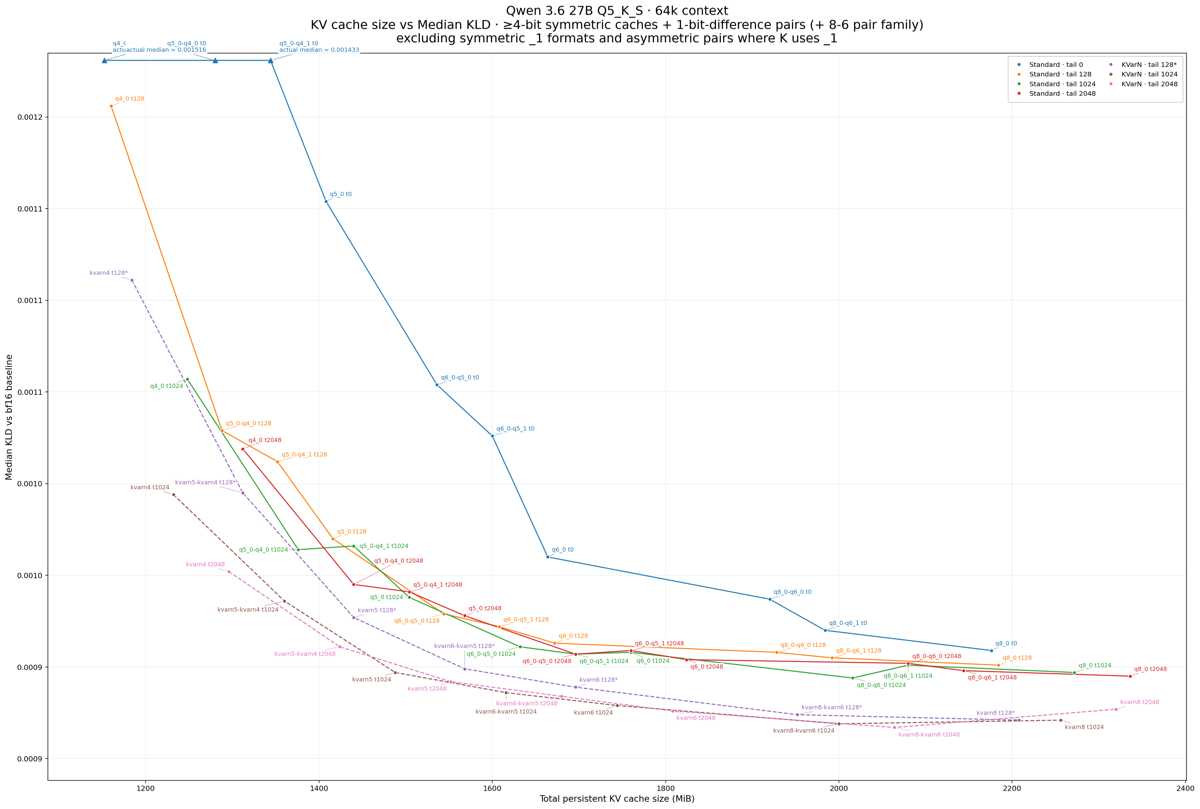
- At a 128-token tail on Qwen, kvarn6 records 0.000889 median KLD in 1696.00 MiB against q8_0’s 0.000901 in 2184.00 MiB — better divergence for 488 MiB less cache.
- kvarn5 comes within 0.000014 of q6_0 (0.000927 vs 0.000913) while using 232.00 MiB less.
- Gemma 4 31B is far more cache-fragile than Qwen. On the shared
kvarn5-kvarn4tail-1024 row, Gemma reads 0.036086 median KLD against Qwen’s 0.000936, and same-top agreement with its own BF16 baseline lands at 80.5% versus Qwen’s 97.976%. - Hardware and setup: one RTX 3090 on Windows 11, batch size 2048, micro-batch 512, seed 1, FlashAttention, unified KV, no mmap, mlock, no host offload, Wikitext-2 raw.
What this means if you’re running models locally
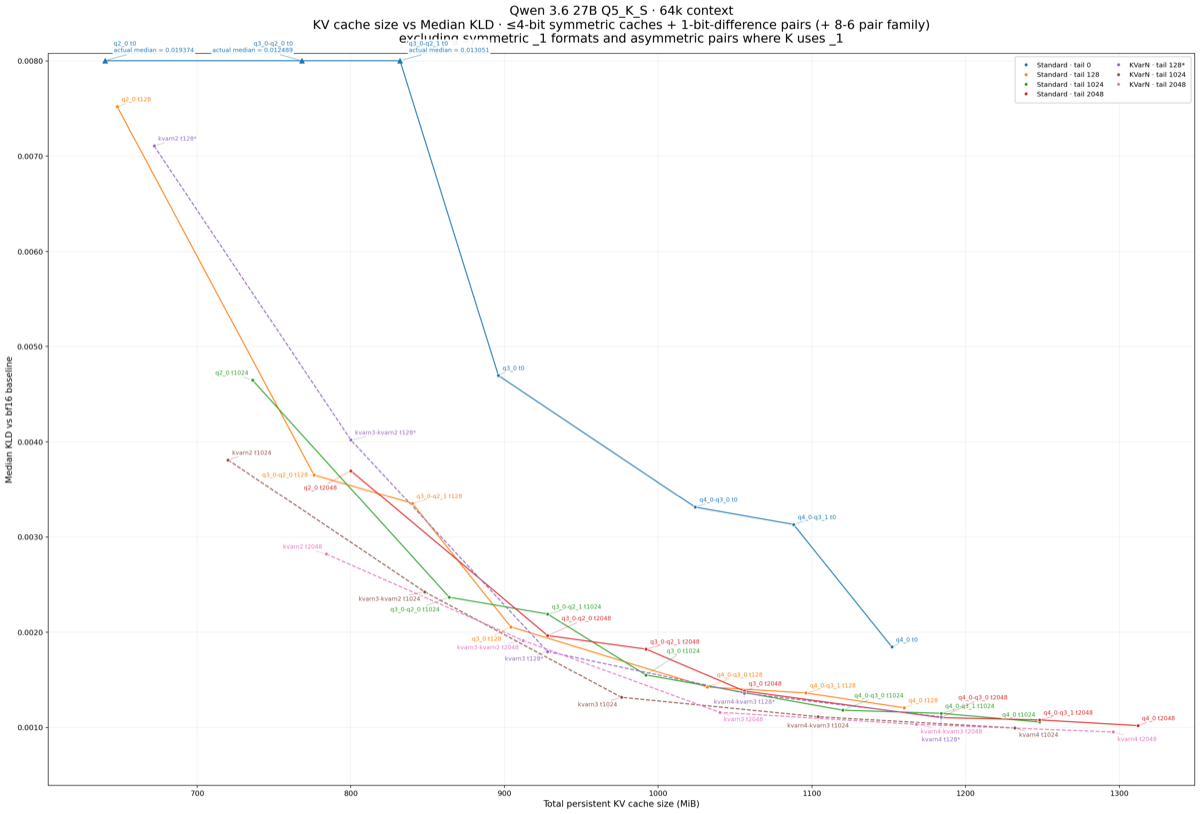
1. The practical ladder is short and worth memorising. On Qwen at tail 1024: q8_0 at 2176 MiB is the safe standard; kvarn6 at 1744 MiB is the high-end value pick (0.000879 median KLD, actually below q8_0’s 0.000909); kvarn5-kvarn4 at 1360 MiB is the balanced default; kvarn4 at 1232 MiB beats q4_0 at 1248 MiB on both size and divergence. Below kvarn3 the numbers degrade fast — kvarn2 at 720 MiB records 0.003811 median and 0.450496 at the 99.9th percentile. That freed VRAM is the point: cache you don’t spend is context length or a larger weight quant you can.
2. The Gemma result is the actionable one. A ~39x divergence gap on an identical cache configuration means KV cache quantization advice does not transfer between model families. If you copied -ctk q4_0 -ctv q4_0 from a Qwen thread into a Gemma 4 31B setup, you are running a much lossier configuration than the person you copied it from — and nothing in your logs will say so. Re-tune per model, or stay at q8_0 on Gemma.
3. Read the 99.9th percentile column, not just the median. Gemma’s q8_0 row is 0.0371 median but 16.813929 at 99.9%. Median KLD tells you the typical token is fine; the tail tells you how badly the worst tokens break. For an agent loop where one wrong tool-call token derails a whole run, the tail column is the one that predicts your failure rate.
4. The author’s own caveat limits the precision-tail numbers. These are teacher-forced Wikitext scores, which grade the next token at every position — so the newest tokens are always decisive context, and even a 128-token exact suffix gets rewarded far beyond what real work would give it. In an agent session the load-bearing tokens are often an earlier instruction or a tool schema sitting well outside the tail. Size the tail to where your important tokens actually live, and treat short-tail rows as optimistic.
5. This is one person, one GPU, one dataset. It is a single RTX 3090 on Windows 11, one weight quant per model, Wikitext-2 only, and the KVarN implementation and the benchmark come from the same author. The method is published in full and the fork is open source, so it is checkable — but nobody has reproduced it independently yet. Verify on your own workload before you rewrite your launch flags.
Sources: Anbeeld, “KV Cache Quantization Benchmarks: KVarN, Precision Tail”, 2026-08-06 · BeeLlama.cpp on GitHub · r/LocalLLaMA discussion thread
Related: Fix llama-server KV cache reuse · Qwen 3.6 for local coding · How to run Gemma 4 12B locally · Speed up Gemma 4 with MTP
Source: Anbeeld