llama.cpp b11895 fixes a Metal large-matrix correctness bug on Apple Silicon
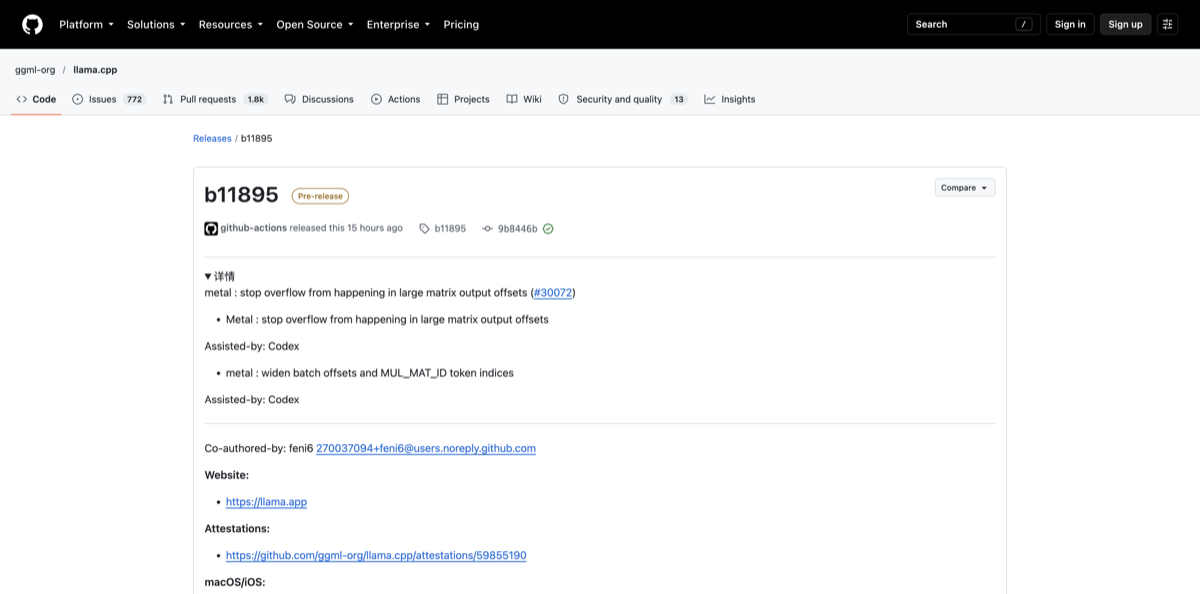
llama.cpp b11895 widens Metal matrix-output offsets to 64-bit arithmetic. The upstream regression test failed before the patch and passed after it on an M4 Pro Mac mini, but it is a large-memory correctness fix—not a general speed claim.
ggml-org published the pre-release llama.cpp b11895 on October 26, 2026. It fixes a Metal bug in large matrix-output offsets by widening their arithmetic to 64-bit values. (Source: llama.cpp b11895 release notes, 2026-10-26)
Key facts:
- b11895 was published on October 26, 2026.
- The patch changes the Metal
kernel_mul_mmoutput-offset arithmetic from 32-bit to 64-bit. - The regression case exceeds the signed 32-bit element range.
- The upstream test needs about 45 GB of peak memory.
- The author reports 1,860 Metal
MUL_MATtests passing after the fix on an M4 Pro Mac mini.
What this means if you run llama.cpp on Apple Silicon
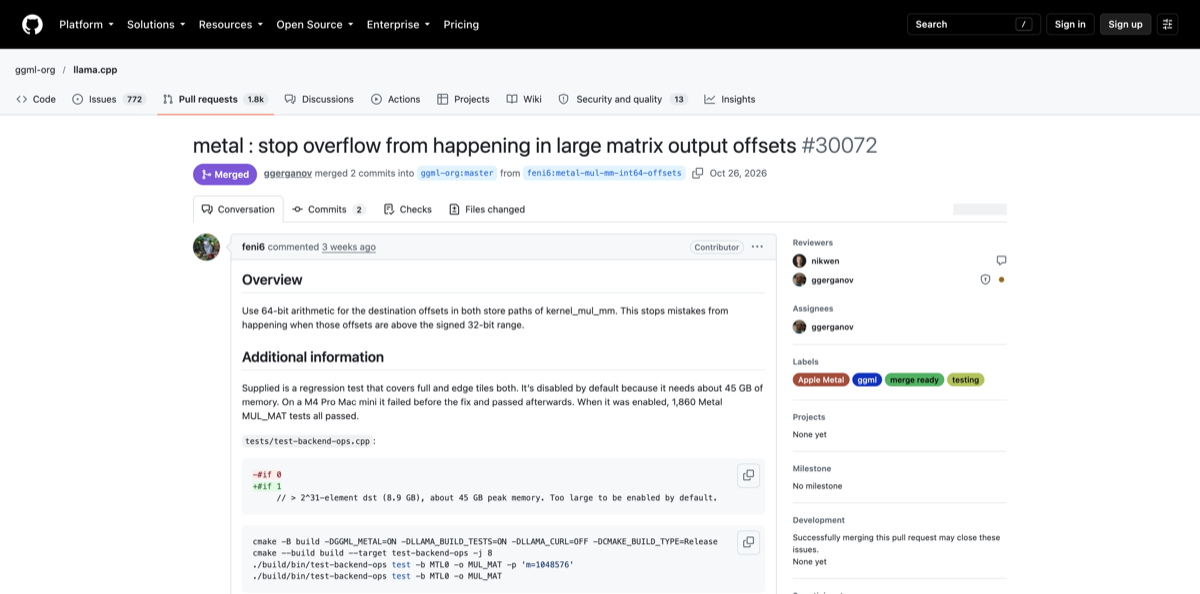
This is a correctness and stability patch, not evidence that ordinary local inference became faster. The merged pull request says both store paths in the Metal matrix-multiply kernel previously used destination offsets that could overflow above the signed 32-bit range. The patch uses 64-bit arithmetic for those offsets. (Source: PR #30072, merged 2026-10-26)
The failure is deliberately extreme. The regression test exercises a destination with more than 2^31 elements and uses about 45 GB of peak memory. On the contributor’s M4 Pro Mac mini with 64 GB of unified memory, the targeted test failed before the patch and passed after it. That establishes the reproduced boundary, not a token-per-second improvement for a normal GGUF chat session. (Source: PR #30072 test report, 2026-10-26)
For a Mac-based builder, update b11895 first if a large batch, embedding job, image/multimodal preprocessing path, or custom integration produces Metal matrix errors at high memory use. Do not upgrade solely to chase a speedup: the release contains no benchmark claiming faster decode or prompt processing. Also, do not assume it cures ordinary server stalls. Repeated-prompt latency is more often a cache configuration question; use our llama-server KV-cache reuse guide to diagnose that separately.
If multiple local agents share a Mac endpoint, validate the nightly in staging with your largest real request before promoting it. Then measure time to first token, generation rate, and memory pressure independently. The llama-server concurrency guide explains why slots and context allocation can still constrain a healthy Metal backend.