MiniMax-H3 now runs on Apple Silicon via MLX — 35.3 GB on disk, and one denoising step takes 8.8 minutes
PipeNetwork published an 8-bit MLX build of MiniMax-H3, the 33B video+audio diffusion transformer MiniMax released on August 2, 2026. Simon Willison ran it on an M5 Max in just under 45 minutes. The port's own README is unusually honest about why: MiniMax hasn't released its sparse-attention implementation, so inference runs dense attention over tens of thousands of rows.
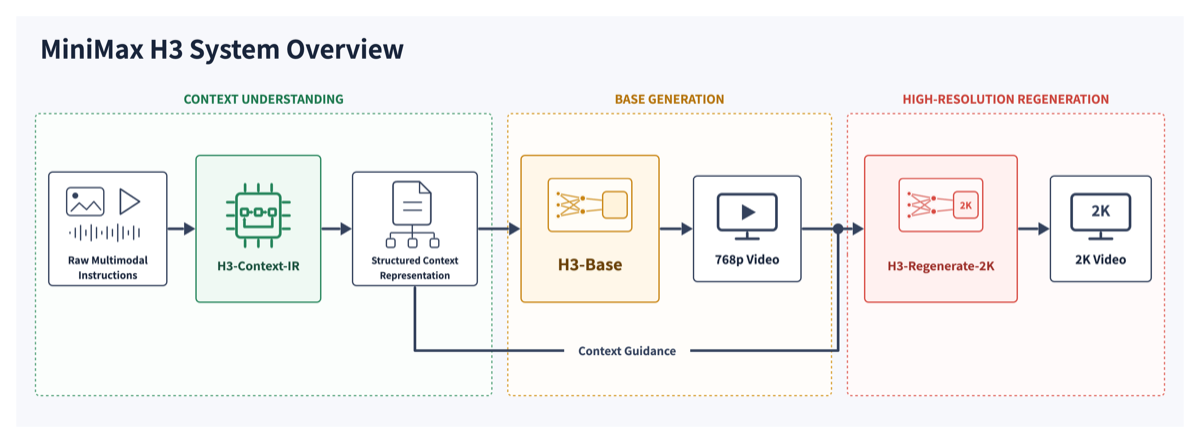
MiniMax released MiniMax-H3 on August 2, 2026, and an 8-bit MLX port for Apple Silicon appeared two days later at pipenetwork/MiniMax-H3-MLX-8bit. (Source: Simon Willison, 2026-08-04) It is not a language model — it is a diffusion transformer that generates video and audio jointly.
Key facts:
- The base model is 33B parameters, a dense diffusion transformer that denoises video and audio latents over one packed sequence, conditioned by a frozen Qwen3-VL-32B encoder. (Source: MiniMax-H3 model card, retrieved 2026-08-05)
- Output is up to 15 seconds of video at 24 FPS with synchronized stereo audio at 32 kHz, 768p native, or 2K via a separate
H3-Regenerate-2Kmodule. - Inputs are text, up to 9 images, up to 3 video clips and up to 3 audio clips (2-15s each).
- The MLX build is 35.3 GB on disk and 21.47 GB resident during generation. (Source: pipenetwork/MiniMax-H3-MLX-8bit README, retrieved 2026-08-05)
- Simon Willison’s actual download was ~115 GB. The MLX repo holds the transformer only; the VAEs and text encoder still come from the upstream MiniMax release.
- One video took just under 45 minutes on an M5 Max MacBook Pro. (Source: Simon Willison, 2026-08-04)
- On an M3 Ultra, a single denoising step costs about 8.8 minutes for a 5-second clip (37,966 packed rows) and 1.04 hours for 15 seconds (109,318 rows).
- The license is the MiniMax H3 Community License, not an open-source license. Commercial products above $20M yearly revenue need separate authorization, and the grant is territorially limited. The MLX port code itself is Apache-2.0.
What this means if you’re building on local models
Most “now runs on a Mac” posts are marketing. This one comes with the arithmetic attached, and the arithmetic is the story.
1. Quantization buys you fit, not speed — and the README says so out loud. From the port’s own docs: “The bottleneck is attention FLOPs, which quantization does not reduce; the linear layers are ~42% of the work at 5 s and ~20% at 15 s, so a 4-bit build is worth roughly 1.2-1.4x end to end. Choose a quant to fit H3 on your machine, not to make it quick.” That sentence should be pinned above every local-model benchmark thread. If your mental model is “smaller quant = faster,” it is wrong for diffusion transformers running dense attention.
2. The disk-versus-resident gap is a real technique, not rounding. About 13B of H3’s 33B parameters are per-block AdaLN projections whose only input is the timestep embedding. For a fixed sampler schedule, every modulation tensor is precomputed once into a table and the projections are dropped — measured at 145 MB for a 9-step schedule against the 26 GB it replaces. That is why 35.3 GB on disk becomes 21.47 GB resident. Worth stealing if you ship diffusion models.
3. The quant floor was measured, not guessed. The port publishes PSNR against bf16 per width: 8-bit at 27.6 dB (near-identical), 4-bit at 22.0 dB (cooler colour, background artifacting, subject intact), 3-bit at 16.3 dB — where, in the author’s words, “the scene is gone.” They also note 3-bit degrades by raising per-frame variance (54.7 vs bfloat16’s 37.1) rather than blurring, so a sharpness metric would have scored it as healthy. 3-bit and 2-bit were built but not published.
Before you download 115 GB. Check the license, not the “open weights” headline. The MiniMax H3 Community License carries a $20M revenue ceiling and excludes certain territories — the port’s README flags this explicitly. And check your patience: at ~8.8 minutes per denoising step for a 5-second clip on an M3 Ultra, a full sampler schedule is an overnight job, not an iteration loop. Simon’s own result also came with “weird speech-like garbage” audio because his prompt gave no audio guidance — the prompting guide matters more than usual here.
If you want the hosted route to MiniMax models instead of 115 GB of local weights, our MiniMax M3 guide covers the API path. For the general “what fits on my machine” calculus, see how to run Gemma 4 26B in 2GB and how to run GLM-5.2 locally.
Sources
Source: Simon Willison