Meta's Muse Glimmer 30B is Apache 2.0 and beats Qwen3.6-27B on MCP Atlas by 13 points — but loses SWE-Bench Verified, TerminalBench and OSWorld
Meta released Muse Glimmer, a 30B dense Apache 2.0 model built for always-on local agents, on August 10, 2026. Its own model card shows it winning tool-orchestration benchmarks by wide margins while losing three of four agentic-coding and computer-use benchmarks to Qwen3.6-27B. That split is the whole story for builders.
Meta released Muse Glimmer on August 10, 2026 — a 30B open-weights model built for agent loops that run on your own machine. (Source: Meta Superintelligence Labs, 2026-08-10)
Key facts:
- The license is Apache 2.0, covering all released artifacts. (Source: Muse Glimmer-30B model card, retrieved 2026-08-11)
- It is a dense causal transformer, ~29.6B parameters including a ~1.8B ViT-G/14 perception encoder. No MoE routing.
- 52 layers, hidden dim 6,656, 32 query heads / 2 KV heads (GQA ratio 16:1), SwiGLU FFN at 19,968 intermediate.
- Attention runs a repeating [Local, Local, Local, Global] pattern with a 2,048-token sliding window, RoPE θ = 500,000.
- Context window is 131,072+ tokens. Vocabulary is 202,048.
- The K-Quant-17GB build is ~17 GB and targets 24 GB VRAM at 1.0% quality degradation; K-Quant-Dynamic targets 32 GB at 0.2%. Full BF16 needs 55+ GB.
- Knowledge cutoff is January 4, 2026.
- Weights are on Hugging Face at
meta-models/Muse-Glimmer-30B, with day-one support in Ollama, LM Studio, llama.cpp, MLX, ExecuTorch, vLLM and SGLang.
The benchmark split is the actual news
Every summary of this release leads with “beats Gemma4-31B and Qwen3.6-27B.” Meta’s own model card is more interesting than that, because it publishes the losses too.
Where Muse Glimmer wins, it wins big — and always on tool orchestration:
| Benchmark | Muse Glimmer-30B | Gemma4-31B | Qwen3.6-27B |
|---|---|---|---|
| MCP Atlas (Public) | 75.5 | 54.2 | 62.5 |
| DeepSearch QA | 74.6 | 61.7 | 71.1 |
| τ3-Banking | 23.5 | 15.1 | 16.7 |
| AA-LCR | 80.0 | 68.3 | 73.3 |
| IFBench | 77.0 | 76.0 | 70.8 |
Where it loses, it loses on doing the work rather than choosing the tool:
| Benchmark | Muse Glimmer-30B | Qwen3.6-27B |
|---|---|---|
| SWE-Bench Verified | 76.0 | 77.2 |
| TerminalBench 2.1 (terminus2) | 51.7 | 60.7 |
| OSWorld-Verified | 65.9 | 75.6 |
| SkillsBench (with skills) | 44.3 | 46.6 |
(Source: Muse Glimmer-30B model card benchmark table, retrieved 2026-08-11. Both models evaluated in thinking / high-reasoning mode.)
What this means if you’re building local agents
1. Pick it for the router, not the worker. A 13-point MCP Atlas lead over Qwen3.6-27B is a large margin on the one benchmark that measures “given 40 tools, call the right one with the right arguments.” If your local agent’s failure mode is picking the wrong MCP server or malforming a tool call, this is a real upgrade. If your failure mode is the patch not applying, Qwen3.6-27B still edges it on SWE-Bench Verified at 3B fewer parameters.
2. The prompt-injection numbers deserve more attention than the coding ones. On Siren AgentDojo, attack success rate is 28.4% for Muse Glimmer against 40.3% for Qwen3.6-27B (lower is better), with utility roughly level at 94.2 vs 92.7. On CI Memories, privacy violation rate is 26.4% vs Qwen’s 53.4%. For an always-on agent reading your email and browsing untrusted pages, halving the injection surface matters more than one SWE-Bench point.
3. DFlash speculative decoding is where the local story gets real. Meta ships a 5-layer drafter that proposes blocks of 16 tokens per forward pass, verified in parallel by the main model.
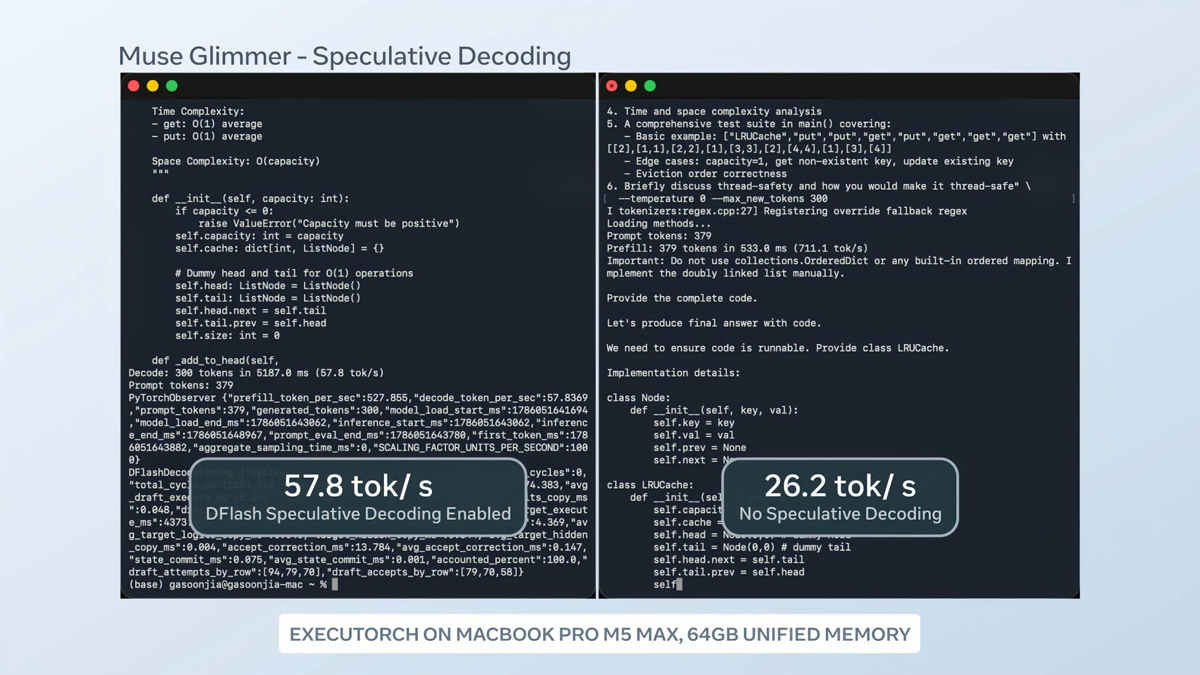
Note the asymmetry: the 5090 gets 3.1x from DFlash, Apple Silicon gets 1.5–1.8x. Speculative decoding pays off most where you have spare compute to burn on verification. On a memory-bandwidth-bound Mac, you get less of it — plan capacity from the 1.8x figure, not the 3.1x headline.
4. Dense is a deliberate choice for this size class. NVIDIA measured 20K tokens/sec per GPU on Blackwell Ultra at BF16/NVF4, and specifically credits the absence of “routing overhead of MoE models” for holding up under concurrency. (Source: NVIDIA Technical Blog, 2026-08-10) A 30B dense model fits a 32 GB RTX 5090 without sharding or CPU offload — that is the entire design constraint.
Before you download 17 GB. The chem/bio preparedness table shows Muse Glimmer scoring below Gemma4-31B on 4 of 6 evaluations — Meta publishes this as a safety result, not a capability regression, but read it as evidence the model was tuned rather than simply scaled. And check the vision tower: 4,096 visual tokens per image at a 2,048-token sliding window means image-heavy agent loops will hit the global-attention layers hard.
For the hands-on path to running a comparable local coding model today, see our Qwen 3.6 local coding setup. If you are sizing quantized weights against your machine, how to run GLM-5.2 locally and how to run Kimi K3 locally cover the same arithmetic.
Sources
- Introducing Muse Glimmer — Meta Superintelligence Labs, 2026-08-10
- meta-models/Muse-Glimmer-30B model card (architecture, full benchmark table, DFlash drafter spec, quantization targets, Apache 2.0 license) — Hugging Face
- Run Local Agentic AI Workflows with Meta’s Muse Glimmer on NVIDIA — NVIDIA Technical Blog, 2026-08-10
- Meta AI Releases Muse Glimmer — MarkTechPost, 2026-08-10
Source: Meta Superintelligence Labs