OpenAI's GPT-5.5, GPT-5.4, and Codex are now generally available on Amazon Bedrock
As of June 1, 2026, OpenAI's GPT-5.5 and GPT-5.4 frontier models — plus the Codex coding agent — are generally available on Amazon Bedrock. Pricing matches OpenAI's first-party rates, usage counts toward your AWS commitments, and Codex inference routes through Bedrock with IAM, VPC isolation, and encryption. Here's what it changes if you build on AWS.
OpenAI’s frontier models and its Codex coding agent reached general availability on Amazon Bedrock on June 1, 2026. (Source: AWS News Blog, 2026-06-01) The move turns AWS into a first-class place to run GPT-5.5 — without leaving your existing Bedrock security, billing, and region setup.
Key facts:
- GA date: June 1, 2026. This followed a limited preview that opened April 28, 2026.
- Three things shipped: GPT-5.5, GPT-5.4, and Codex, OpenAI’s coding agent.
- The open-weight gpt-oss-120b and gpt-oss-20b models are on Bedrock too.
- Pricing matches OpenAI’s first-party rates. There are no additional AWS fees.
- You pay per token — no seat licenses, no per-developer commitments.
- Usage counts toward your existing AWS commitments.
- GPT-5.5 is available in US East (Ohio). GPT-5.4 is in US East (Ohio) and US West (Oregon).
- More than 4 million developers use Codex every week. (Source: AWS News Blog, 2026-06-01)
What actually shipped
The model IDs you call are plain: openai.gpt-5.5 and openai.gpt-5.4. Both run through the same Bedrock APIs you already use for Claude or Nova, so adding GPT-5.5 to an existing app is a model-string change, not a new integration.
The bigger news for builders is Codex itself. The agent is available through the Codex CLI, the Codex desktop app, and IDE integrations for Visual Studio Code, JetBrains, and Xcode — and every one of them can route inference through Bedrock. You authenticate with an Amazon Bedrock API key or the standard AWS SDK credential chain, and requests go through Bedrock’s Responses API under the same IAM, VPC isolation, and encryption controls your account already enforces.
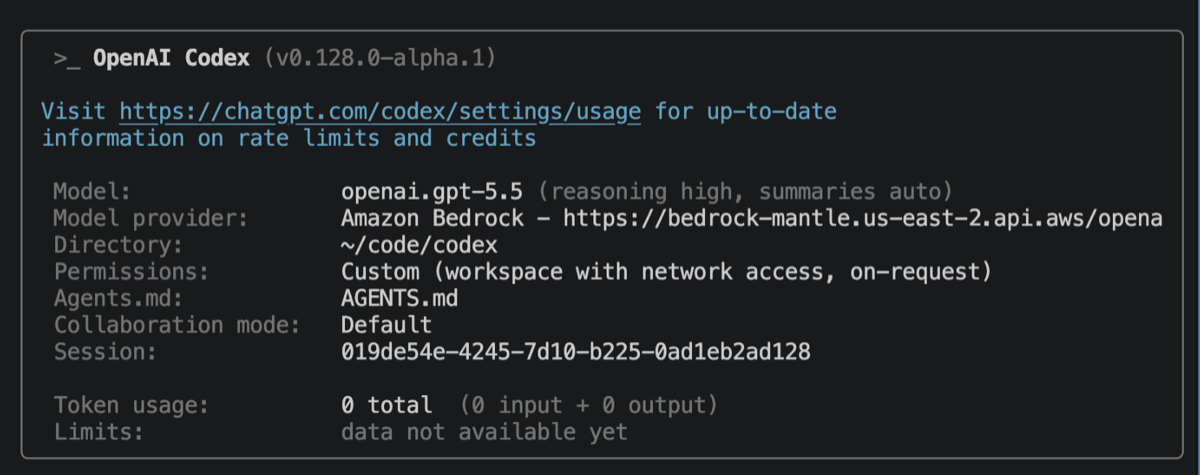
openai.gpt-5.5 and its provider as Amazon Bedrock — inference stays inside your AWS boundary. (Source: AWS News Blog)What this means if you’re building on AWS
The friction this removes is procurement and data-path, not capability. Before, an AWS-committed team that wanted Codex had to send code and prompts to a separate OpenAI account — a second vendor, a second bill, and a second egress path past your VPC. Now the agent runs through Bedrock: spend draws down your AWS commitment, traffic stays inside your account’s IAM and VPC boundary, and there’s no per-seat license to negotiate.
That changes the build-vs-buy math for unattended coding work. If you’ve been weighing which agent to trust with long, auditable runs, our Claude Code vs Codex head-to-head lays out where each one wins. And if you’re deciding whether a frontier agent should be your everyday driver at all, the trade-offs in running Claude Code as a daily driver apply directly — the same token-metering and fallback discipline holds whether the bill lands on OpenAI, Anthropic, or AWS.
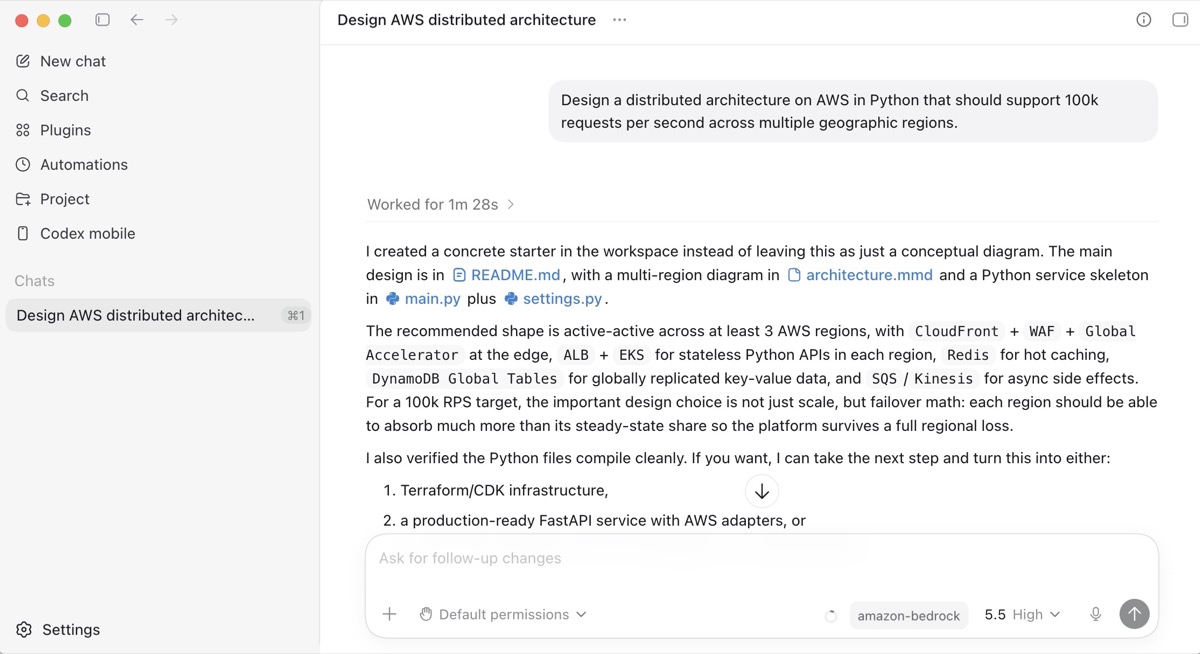
amazon-bedrock and GPT-5.5 on the "High" reasoning tier. (Source: AWS News Blog)The catch
Region coverage is still thin. GPT-5.5 only lives in US East (Ohio) at launch, so if your workloads run in Europe or Asia, you’re making a cross-region call until AWS expands availability. Pricing matching OpenAI’s first-party rates also means Bedrock is not cheaper here — the win is consolidation and security posture, not a discount. Check the model’s region list against where your data must stay before you wire Codex into a production pipeline.
Sources
- Get started with OpenAI GPT-5.5, GPT-5.4 models, and Codex on Amazon Bedrock — AWS News Blog, 2026-06-01
- OpenAI frontier models and Codex are now available on AWS — OpenAI, 2026-06-01
- AWS and OpenAI announce expanded partnership to bring OpenAI models to Bedrock — About Amazon
Source: AWS News Blog