Alibaba is banning Claude Code internally from July 10 — here's the governance question every team should now ask
Alibaba told staff to uninstall Claude Code and move to its own agent IDE, Qoder, by July 10, 2026, after a researcher found the tool fingerprinted proxy and timezone settings against a hidden list of Chinese firms. Anthropic says it was an anti-distillation experiment already removed on July 1. For builders, the real lesson is about auditing closed-source coding agents — not picking a side.
Alibaba is banning employees from using Anthropic’s Claude Code in internal work environments, effective July 10, 2026, according to an internal notice first reported by the South China Morning Post and Reuters. (Source: The Next Web / Reuters, 2026-07-03) Staff are told to migrate to Qoder, Alibaba’s own agentic coding IDE.
Key facts:
- The ban takes effect July 10, 2026 and targets Claude Code specifically, not all Claude products. (Source: The Next Web, 2026-07-03)
- It is sourced from an internal notice (“source says”) — Alibaba has not issued a public statement.
- Staff are directed to Qoder, Alibaba’s own agentic coding platform (launched August 2025, 5M+ users). (Source: Alibaba/Yahoo Finance, 2026)
- The trigger: a June 30 reverse-engineering post claimed Claude Code, since build 2.1.91 (April 2, 2026), silently checked proxy config and system timezone and compared them against hidden lists naming Alibaba, Baidu, ByteDance, and Moonshot AI. (Source: cybersecuritynews.com, 2026-07-01)
- Anthropic engineer Thariq Shihipar called it “an experiment we launched in March that was meant to prevent account abuse from unauthorized resellers and protect against distillation,” and said the code was removed on July 1 (Claude Code v2.1.197). (Source: The Register, 2026-07-01)
- No third-party security firm has confirmed a “backdoor.”
What actually happened
This is the enterprise fallout from the Claude Code steganography story that broke on July 1. The mechanism didn’t exfiltrate files or run remote commands. It only activated when ANTHROPIC_BASE_URL pointed at a custom, non-Anthropic endpoint — a proxy, gateway, or reseller — then encoded a proxy/environment classification into the system prompt sent back to Anthropic’s own servers, using look-alike Unicode characters. (Source: The Register, 2026-07-01)

The context matters. Anthropic accused operators linked to Alibaba’s Qwen lab of running the largest known model-distillation campaign against Claude — ~25,000 fraudulent accounts generating more than 28 million interactions between April and June 2026, cited in a June 10 letter to the US Senate Banking Committee. (Source: The Next Web / Reuters, 2026-07-03) The environment fingerprinting was Anthropic’s countermeasure. Alibaba’s ban is the retaliation. Reading either move as a clean “spyware” or “safety” story misses that this is a two-sided IP war.
What this means if you’re building with AI coding agents
The takeaway for builders isn’t “trust Anthropic” or “trust Alibaba” — it’s that a closed-source coding CLI is a data-egress surface that can inspect your environment, and most teams never audit that. Three concrete moves:
- Treat vendor CLIs as untrusted at the network boundary. The marking only fired behind a custom
ANTHROPIC_BASE_URL. If you route Claude Code (or any agent) through a corporate proxy, LLM gateway, or reseller, assume the vendor can tell — and decide whether that’s acceptable before procurement, not after a Reddit thread. - Pin and diff versions. The behavior landed in a specific build (2.1.91) with no changelog note, and was removed in another (2.1.197) with no changelog note. Enterprises that pin agent versions and diff binaries between updates catch this class of change; teams on auto-update don’t.
- Keep model and harness config-driven so you can swap. Alibaba could switch to Qoder in a day because it had a built alternative. If Claude Code is load-bearing in your CI, having a self-hostable fallback — an open-weight coding model like Kimi K2.7 Code or a local Qwen setup behind the same agent interface — turns a vendor incident from a fire drill into a config flag.
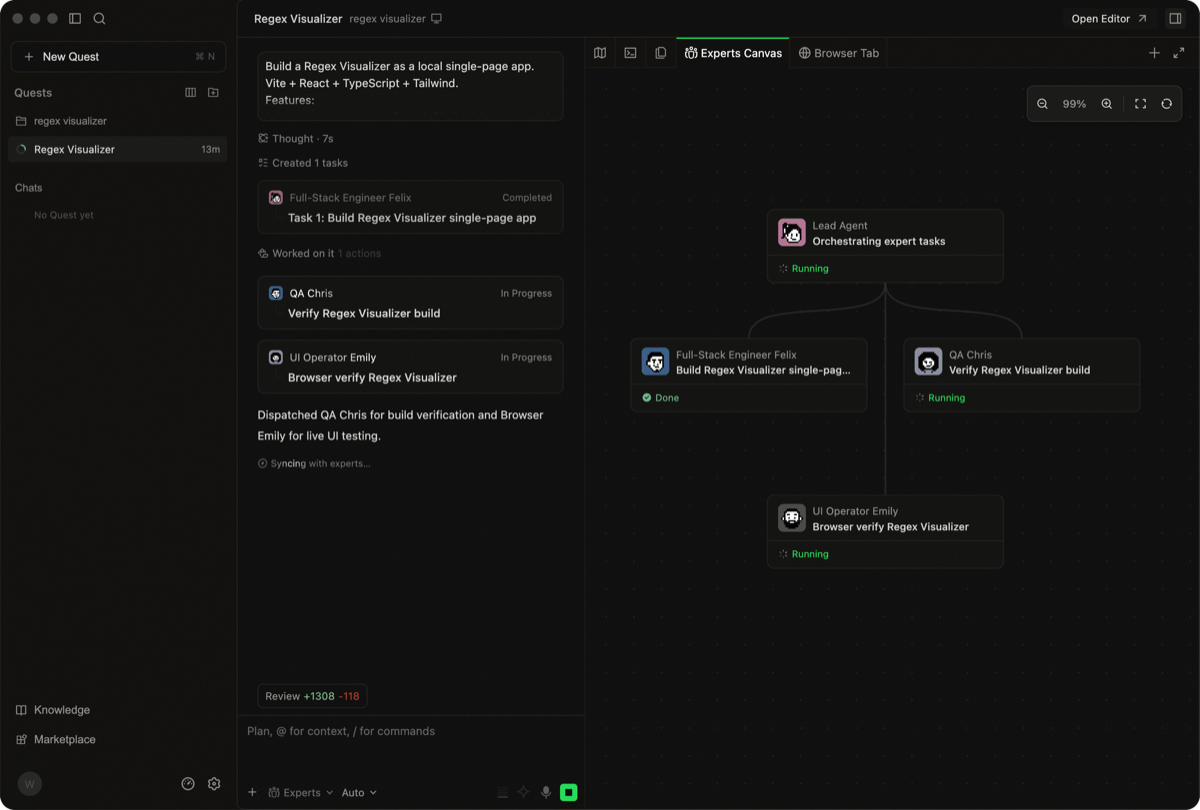
Qoder itself is a real product, not a face-saving stub — a multi-agent IDE with a “quest” delegation model and codebase-wiki generation:
None of this requires believing Anthropic acted in bad faith — its rationale is documented and the code is gone. It requires accepting that you can’t audit what you can’t see, and building your agent stack so a single vendor’s opaque decision can’t quietly reshape your build.
Sources
- The Next Web — “Alibaba bans Claude Code over hidden Chinese user tracking” (2026-07-03)
- Reuters via KFGO — “Alibaba to ban Claude Code in workplace over alleged backdoor risks, source says” (2026-07-03)
- The Register — “Anthropic is removing its covert code for catching Chinese competitors” (2026-07-01)
- Cybersecurity News — “Alibaba to Ban Claude Code Over Alleged Embedded Backdoor Risks” (2026-07-03)
Source: The Next Web / Reuters