Kimi K2.7 Code is a 1T open-weight coding agent that uses 30% fewer thinking tokens
Moonshot AI released Kimi K2.7 Code on June 12, 2026 — a 1-trillion-parameter (32B active) Mixture-of-Experts coding model with a 256K context, free weights under a Modified MIT license, and roughly 30% lower reasoning-token use than K2.6. It trails GPT-5.5 and Claude Opus 4.8 on raw coding benchmarks but edges Opus 4.8 on MCPMark tool-use. Here's what it means if you build with coding agents.
Moonshot AI released Kimi K2.7 Code on June 12, 2026 — an open-weight, coding-focused agentic model built on top of Kimi K2.6. (Source: Moonshot AI Hugging Face model card, 2026-06-12) For builders, the headline isn’t a frontier benchmark crown — it’s that the weights are free under a Modified MIT license and the model is tuned to spend fewer “thinking” tokens, which directly lowers the cost of long-running agent loops.
Key facts:
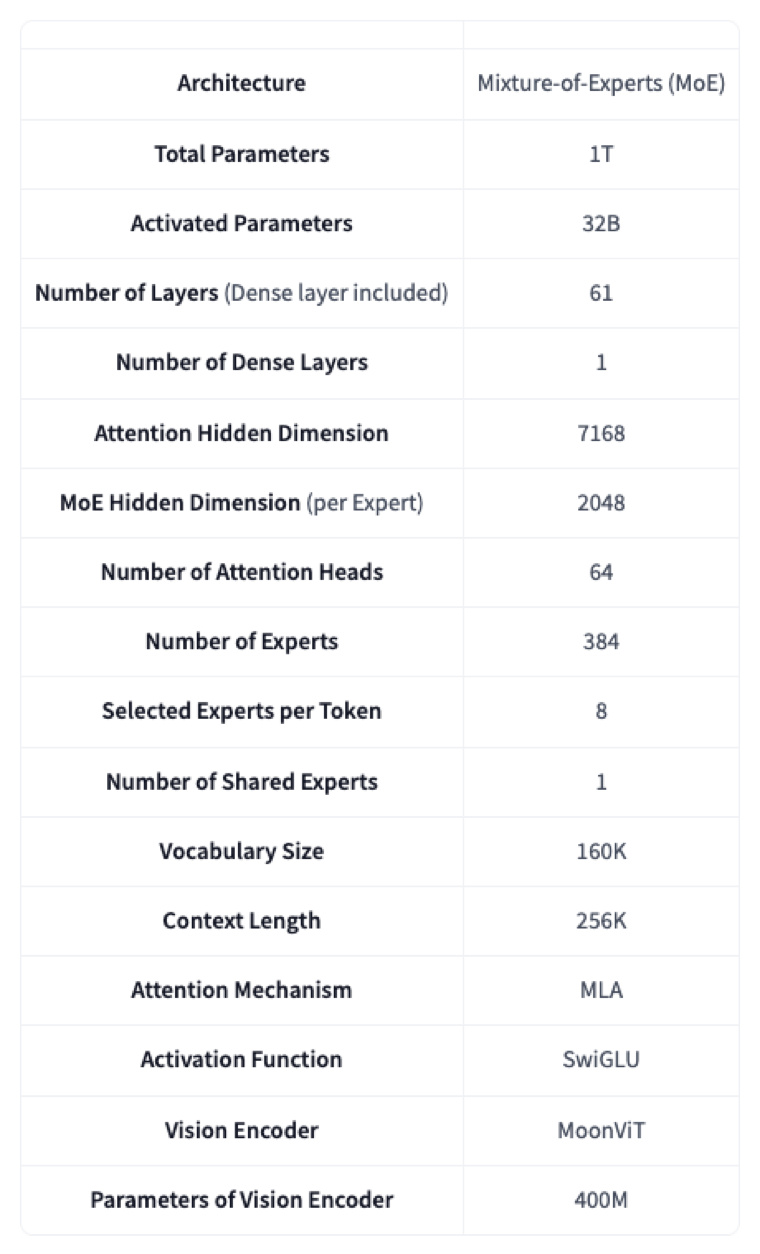
- It is a 1-trillion-parameter Mixture-of-Experts model with 32B active parameters. It has 384 experts, selects 8 per token, plus 1 shared expert. (Source: Moonshot AI model card, 2026-06-12)
- The context window is 256K tokens. It uses MLA attention and a 160K vocabulary, and ships a 400M-parameter MoonViT vision encoder for image and video input.
- It uses roughly 30% fewer reasoning tokens than Kimi K2.6 on Moonshot’s own coding benchmarks — “less overthinking” on long-horizon tasks. This is vendor-measured and workload-dependent.
- The weights are released under a Modified MIT license on Hugging Face, so you can self-host.
- The API is OpenAI- and Anthropic-compatible, served from
https://platform.moonshot.ai.
Where it actually lands
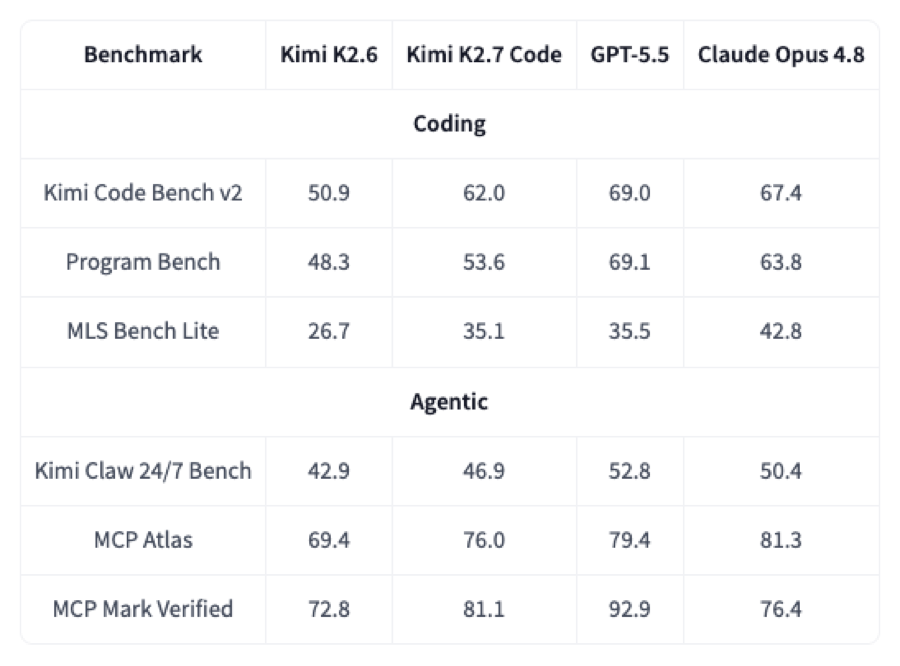
Be honest about the benchmarks: on Moonshot’s own table, K2.7 Code does not beat the frontier on raw coding. It scores 62.0 on Kimi Code Bench v2 versus 69.0 for GPT-5.5 and 67.4 for Claude Opus 4.8, and 53.6 on Program Bench versus 69.1 and 63.8. (Source: Moonshot AI model card, 2026-06-12) The real story is two things: the jump over its own predecessor (Kimi Code Bench v2 went from 50.9 to 62.0, a 21.8% gain), and one place it leads — MCP Mark Verified, where K2.7 Code scores 81.1 versus Opus 4.8’s 76.4, suggesting it is competitive at MCP-style tool calling.
What it means if you’re building
The open weights plus the OpenAI/Anthropic-compatible API make this a low-friction drop-in. Moonshot says K2.7 Code works through compatible endpoints in coding agents like Claude Code, Cline, and Roo Code, and ships inside Kimi Code, its open-source TypeScript CLI. (Source: digitalapplied analysis, 2026-06-12) If you already run Claude Code as a daily driver, pointing it at a Kimi endpoint is a config change, not a rewrite — the same way you’d swap in Qwen3.7-Max or DeepSeek’s Reasonix to compare open coding models.
The token-efficiency claim is the part worth testing yourself: 30% fewer reasoning tokens, if it holds on your repos, means cheaper and faster agent runs at similar quality — which can matter more than a few benchmark points on a leaderboard you don’t control.
Two honest caveats. Standalone per-token API pricing had not been published at launch (only Kimi Code membership tiers from roughly $19 to $199 per month were listed), so budget against the free self-hosted weights or membership, not a confirmed token rate. (Source: digitalapplied analysis, 2026-06-12) And the benchmark numbers are Moonshot’s own — wait for independent SWE-Bench Pro and Terminal-Bench re-runs before betting a platform decision on them, the same caution that applies to any vendor table, including Claude Code vs Codex comparisons.
Sources
- Moonshot AI — Kimi K2.7 Code model card (Hugging Face) — official architecture, benchmark table, license, API compatibility
- Moonshot AI / Kimi developer platform — API access, OpenAI/Anthropic-compatible endpoints
- digitalapplied — Kimi K2.7-Code: Moonshot’s coding-first open-source release — release date, agent compatibility, pricing status, builder takeaways