DeepSeek Vision is live — as a chat-only beta, not yet an API builders can call
DeepSeek added a Vision (image-recognition) mode to its chat app in June 2026, the first time its consumer chatbot can read images. It's a limited beta for select users on web and mobile — there's no public vision API model ID yet. Here's what it means if you're building image or document pipelines on DeepSeek.
DeepSeek has added a Vision (image-recognition) mode to its chat app — the first time its consumer chatbot can read images instead of just text. (Source: South China Morning Post) It surfaced on Hacker News on June 17, 2026 and is rolling out as a limited beta to select users on DeepSeek’s website and mobile app. If you build on DeepSeek, the important detail is what is not shipping yet: a callable vision API.
Key facts:
- DeepSeek added an image-recognition mode to its chat, alongside the existing “Instant” and “Expert” modes. (Source: South China Morning Post)
- This is the first multimodal capability in DeepSeek’s consumer chatbot — it can now process images, not only text. (Source: South China Morning Post)
- It is a beta, limited to select users on web and mobile for testing. (Source: SCMP, citing DeepSeek multimodal team lead Chen Xiaokang)
- The rollout follows DeepSeek’s V4 flagship launch (V4-Pro and V4-Flash, open-weight under MIT, shipped April 2026). (Source: llm-stats AI updates)
- There is no public vision API model ID announced for this chat feature yet — it is a product feature, not a developer endpoint. (Source: DeepSeek API docs as of this writing)
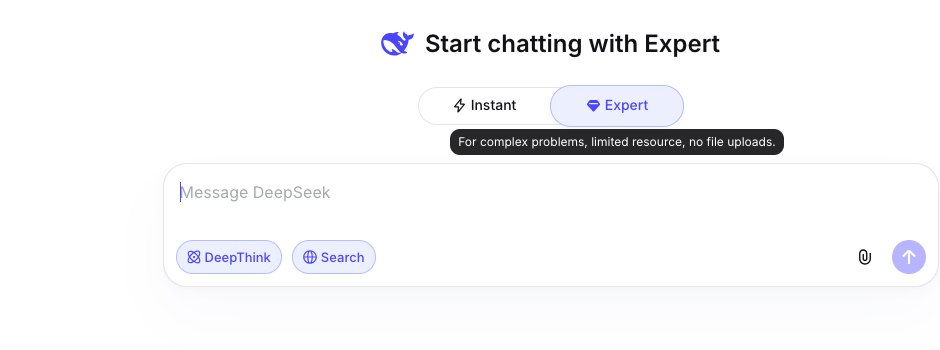
What actually shipped
The headline — “the whale can now see” — is accurate but narrow. (Source: South China Morning Post) What landed is a mode inside the chat product: you pick image-recognition the same way you pick Instant or Expert, then upload a picture and ask about it. According to DeepSeek’s multimodal team lead Chen Xiaokang, the function went first to a subset of users on the website and mobile app for beta testing. (Source: SCMP)
That product surface is the one shown above: the mode toggle, the file-attach paperclip, the same composer DeepSeek shipped with its V4 release. Vision plugs into it. What did not arrive is a documented deepseek-vision-style model ID you can hit from code. The reporting frames this as DeepSeek catching up to other multimodal chat apps and sharpening China’s AI price war — a consumer move first. (Source: Startup Fortune; Phemex News)
What it means if you’re building
If your plan was to call DeepSeek’s vision from a script today, you can’t — there’s no vision API behind this beta yet. So treat this as a signal, not a dependency: DeepSeek is clearly productizing multimodal, and a priced vision endpoint is the likely next step. Watch the API docs for a new model ID, and don’t rewire a production pipeline around a chat feature you can only click.
If you need image or document understanding in a pipeline right now, the practical path hasn’t changed. Use a vision-language model you can actually call or self-host. DeepSeek itself already ships open-weight VL and OCR models under MIT that you can run yourself, and there are hosted VLMs with stable APIs. Our walkthrough on building a Qwen3-VL document-extraction pipeline shows the end-to-end shape — typed schema, validation, retries, concurrency — and the same code structure swaps cleanly to another VLM. For self-hosted small extractors, running NuExtract 3 locally covers the trade-off between a big general VLM and a specialized small model.
The durable lesson is the one DeepSeek’s price war keeps teaching: keep the vision model behind a config flag. When DeepSeek’s vision API does ship — likely much cheaper than incumbents — swapping it in should be a model-string change, not a rewrite. Build the pipeline now on whatever VLM you can call, and let the cheapest viable provider win at config time.
Sources
- South China Morning Post — “The whale can now see”: DeepSeek adds AI vision in major move — image-recognition mode, beta to select users, team lead Chen Xiaokang
- Phemex News — DeepSeek Launches Vision Feature for Image Analysis — new image-recognition mode added to chat modes
- Startup Fortune — DeepSeek adds vision and the Chinese AI price war just got sharper — price-war and competitive framing
- Hacker News — DeepSeek Introduces Vision (discussion) — surfaced June 17, 2026
Source: South China Morning Post