Gemini Robotics ER 2 ships to the Gemini API — and it's a video-understanding model you can call without a robot
Google launched Gemini Robotics ER 2 on July 30, 2026, available to developers as gemini-robotics-er-2-preview in the Gemini API and AI Studio. It scores 57.4% on progress classification and 91.3% on moment-finding with 0.96s mean absolute distance. The robotics framing hides the part builders care about: continuous video progress tracking through the Live API.
Google launched Gemini Robotics ER 2 on July 30, 2026. (Source: Google DeepMind, 2026-07-30) It is publicly available to developers today — not gated behind a robotics partner program.
Key facts:
- The API model ID is
gemini-robotics-er-2-preview. A streaming variant,gemini-robotics-er-2-streaming-preview, is also listed. (Source: Gemini API robotics docs, retrieved 2026-07-31) - Access is via the Gemini API and Google AI Studio, plus private preview on the Gemini Enterprise Agent Platform. (Source: Google DeepMind, 2026-07-30)
- Context limits are 131,072 input tokens and 65,536 output tokens. (Source: Gemini API robotics docs)
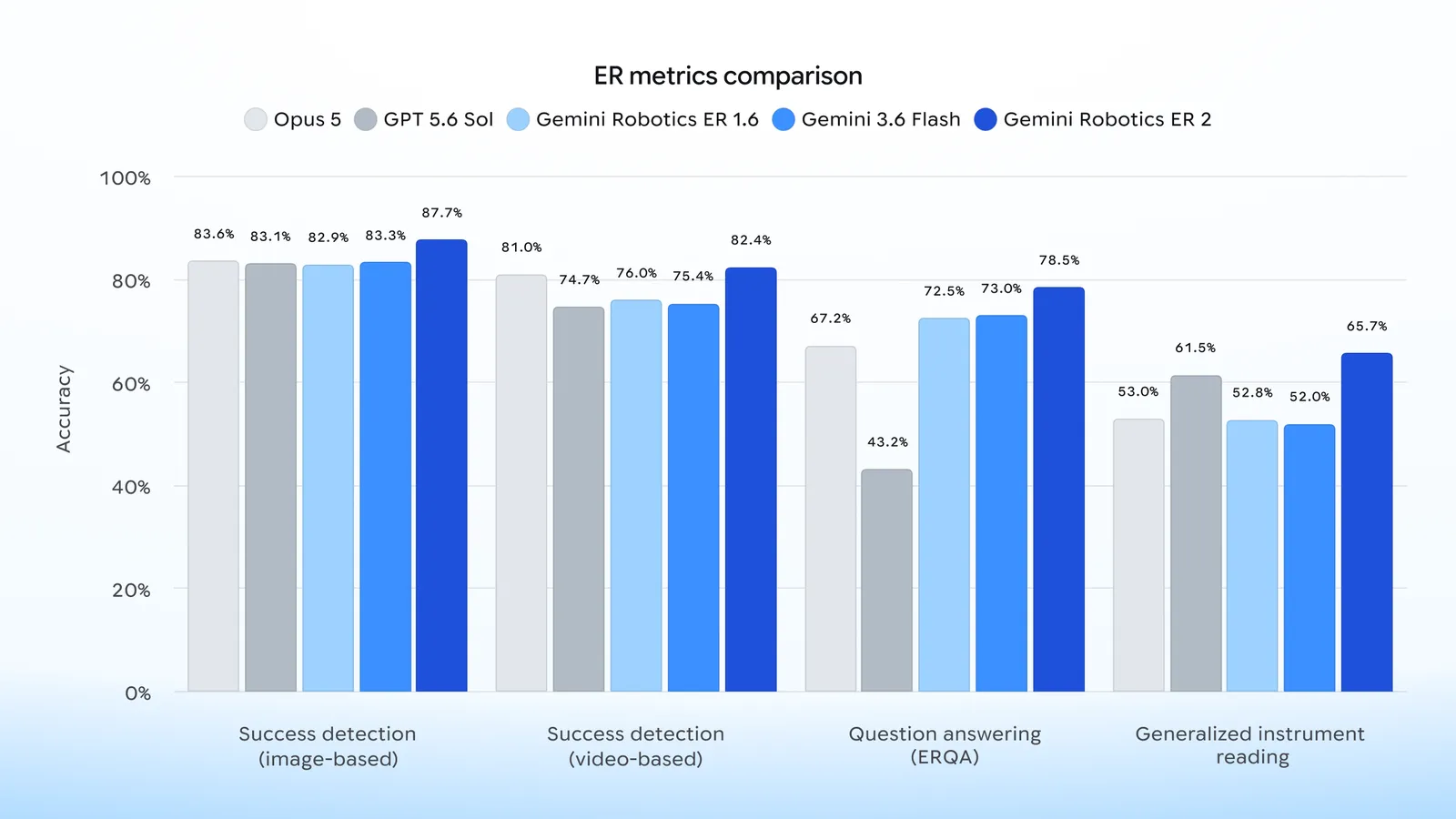
- Progress classification accuracy is 57.4% — the model sorts each frame of a video feed into one of five completion bands (0-20%, 20-40%, 40-60%, 60-80%, 80-100%).
- Moment-finding accuracy is 91.3%, with a 0.96s mean absolute distance — finding the exact frame where a critical event happens, at what Google calls “4x the execution speed” of much larger model categories.
- It integrates with the Gemini Live API over a bidirectional streaming endpoint for latency-sensitive work.
- Demos ship with Boston Dynamics’ Spot, Apptronik’s Apollo 2, and Franka F3 Duo. Code examples are on GitHub at google-gemini/robotics-samples.
What this means if you’re building with the Gemini API — and you own zero robots
The word “robotics” in the name will make most web and agent developers scroll past. That’s a mistake, for three concrete reasons.
1. “Did the task actually finish?” is the hardest question in every agent loop, not just robot ones. Google built ER 2 around exactly that problem: progress classification and moment-finding are ways of asking a video stream “how far along is this, and when did the thing happen?” Swap the robot arm for a screen recording of a browser agent, a security camera, or a manufacturing line, and the capability is the same. A model that assigns a completion percentage to each frame is a verification primitive.
2. The orchestration shape is a normal tool-calling agent. Google’s description is that developers “declare low-level control interfaces — like Vision-Language-Action (VLA) models or navigation APIs — as tools, and stream multimodal video, audio, or text directly into the model.” That is the same tools array you already write, with a video stream on the input side. ER 2 also natively calls Google Search and user-defined functions.
3. It runs over the Live API’s bidirectional streaming endpoint. That is the piece that makes continuous video supervision practical instead of a batch job — you are not uploading a finished clip and waiting, you are watching. The trade-off Google names is a small model tuned for sub-second latency rather than a large one: 91.3% moment-finding accuracy that “competes closely with much larger model categories” at “a fraction of the compute cost.”
What Google did not publish: per-token pricing for the robotics models. The docs point to the general pricing page rather than quoting rates, so budget this one by measuring, not by reading. Every benchmark above is vendor-reported on Google’s own evaluations, including the safety claims about halting near humans — treat them as a starting hypothesis for your own eval, not a result.
If you want the surrounding machinery — server-side tool loops, background execution, remote MCP — our guide to Gemini API managed agents covers the Interactions API those patterns run on. For picking the general-purpose model to pair with ER 2 in the same pipeline, see Gemini 3.5 Flash and the cheaper high-volume option, Gemini Omni Flash.
Sources
Source: Google Blog / Google DeepMind