Claude Fable leaves subscriptions July 7 — here's what a real release cost with it
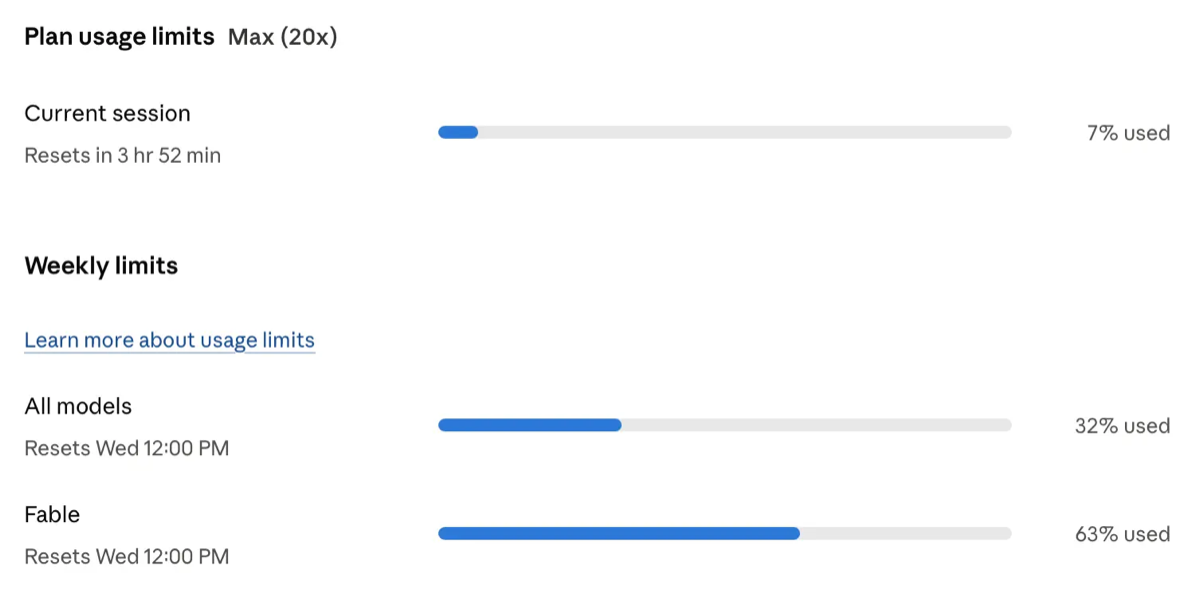
On July 7, 2026, Anthropic pulls Claude Fable 5 out of Pro, Max, Team, and select Enterprise plans; after that, Fable runs on metered credits at API rates ($10/M input, $50/M output). Simon Willison shipped a full sqlite-utils release with Fable just before the cutoff for $149.25 — concrete data on what agentic coding actually costs once the subscription cushion is gone.
Anthropic is pulling Claude Fable 5 out of standard subscriptions on July 7, 2026. (Source: BleepingComputer / Digital Trends, 2026-07-04) After that date, Pro, Max, Team, and select Enterprise users keep access only by buying metered credits at full API rates — and the day before the cutoff, Simon Willison published a concrete data point on what that actually costs: a full sqlite-utils release shipped mostly by Fable for $149.25. (Source: Simon Willison’s Weblog, 2026-07-05)
Key facts:
- Fable 5 comes off Pro, Max, Team, and select Enterprise plans on July 7, 2026. (Source: BleepingComputer, 2026-07-04)
- After July 7, Fable runs on metered credits at API rates: $10 per million input tokens and $50 per million output tokens, stacked on top of your existing subscription. (Source: Digital Trends, 2026-07-04)
- Anthropic says the change is temporary and driven by compute scarcity, not strategy. A Claude Code lead engineer wrote: “While it will come off subscriptions after July 7th, we aim to restore Fable as a standard part of our subscriptions as soon as capacity allows.” (Source: BleepingComputer, 2026-07-04)
- Simon Willison’s sqlite-utils 4.0rc2 release cost $149.25 across 37 prompts and 34 commits, mostly written by Fable. (Source: Simon Willison’s Weblog, 2026-07-05)
Why this is the number that matters
Once the subscription cushion is gone, “how good is Fable?” becomes “what does Fable cost per shipped thing?” — and Willison’s release is one of the few public, itemized answers. The return of Fable to global access on July 1 after the export-control suspension restored availability; the July 7 change removes the flat-rate economics that made heavy agentic use feel free.
His workflow notes are the actionable part. He ran cross-model review — having GPT-5.5 review Fable’s work to catch edge cases — and concluded he “should have leaned more heavily into subagents with cheaper models,” since most of the $149.25 sat in one expensive main session ($141.02) while cheap subagents handled the rest for $8.23. At $10/$50 per million tokens, that split is the whole ballgame.
What it means if you’re building
If Fable is in your loop, three moves before July 7. First, instrument cost now — put a per-agent token meter on every loop so you can see which sessions are worth API rates and which should fall back to a cheaper model, exactly the subagent-routing lesson Willison paid to learn. Second, keep the model string in config, so switching Fable off — or down to Opus 4.8 — is a one-line change, not a rewrite; our guides on switching to Fable 5 and switching to Opus 4.8 both assume a swappable model config. Third, reserve Fable for the tasks that pay for themselves — Willison’s point that release notes are ideal AI work (“boring, predictable and accurate”) is a good filter: expensive models earn their rate on well-scoped, verifiable tasks, not open-ended exploration. If you run Claude Code as a daily driver, the metered era rewards knowing your token budget per task.
Sources
- Simon Willison — sqlite-utils 4.0rc2, mostly written by Claude Fable — the $149.25 cost breakdown, workflow, cross-model review, subagent lessons
- BleepingComputer — Claude Fable 5 isn’t permanently leaving subscriptions, Anthropic says — July 7 date, temporary framing, Claude Code engineer quote
- Digital Trends — Claude Fable 5 is leaving subscriptions, but maybe not for good — metered API rates ($10/M input, $50/M output), affected plans
Source: Simon Willison's Weblog