Claude Sonnet 5 ships: Opus-class performance, a new tokenizer that quietly raises the bill
Anthropic released Claude Sonnet 5 on June 30, 2026 — its 'most agentic Sonnet yet,' with 1M context, 128K output, and benchmarks that land between Sonnet 4.6 and Opus 4.8. Intro pricing is $2/$10 per 1M tokens. The catch builders need to know: a new tokenizer produces ~30% more tokens, so the real cost is higher than the sticker.
Anthropic released Claude Sonnet 5 on June 30, 2026, calling it “the most agentic Sonnet model yet.” (Source: Anthropic, 2026-06-30) For builders, the headline is that a mid-tier Sonnet now lands close to Opus 4.8 on agentic tasks — but a new tokenizer means the advertised price isn’t the price you’ll actually pay.
Key facts:
- Model ID:
claude-sonnet-5. It succeeds Sonnet 4.6. - Intro pricing: $2 / $10 per 1M input/output tokens, through August 31, 2026. Standard pricing after that is $3 / $15. (Source: Anthropic, 2026-06-30)
- Context window: 1 million tokens. Max output: 128,000 tokens. (Source: Simon Willison, 2026-06-30)
- Sampling parameters (
temperature,top_p,top_k) are no longer supported. Adaptive thinking is on by default; disable it with"thinking": {"type": "disabled"}. - It is now the default model on Free and Pro plans, and is available via Claude Code, the Claude API, Max, Team, and Enterprise.
Where it lands on benchmarks
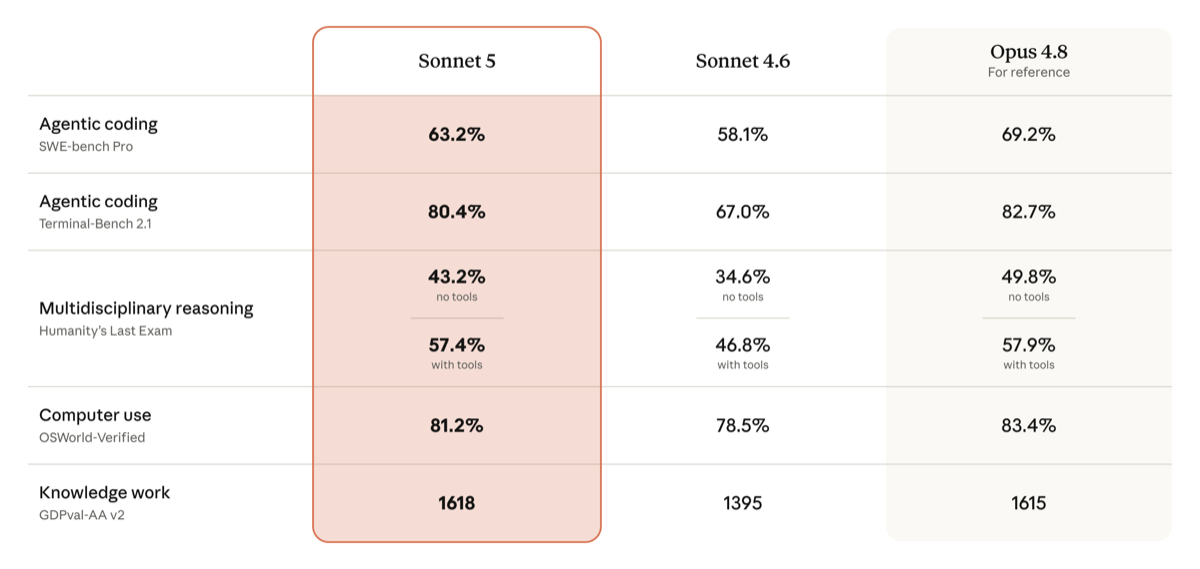
Anthropic’s own comparison table puts Sonnet 5 above Sonnet 4.6 across the board, and within a few points of Opus 4.8 on several agentic evals.
The numbers that matter if you build agents:
- SWE-bench Pro (agentic coding): 63.2% — up from Sonnet 4.6’s 58.1%, below Opus 4.8’s 69.2%.
- Terminal-Bench 2.1: 80.4% — a big jump from 67.0%, and nearly Opus 4.8’s 82.7%.
- OSWorld-Verified (computer use): 81.2% — versus 78.5% (Sonnet 4.6) and 83.4% (Opus 4.8).
- Humanity’s Last Exam, with tools: 57.4% — essentially tied with Opus 4.8’s 57.9%.
So on coding and computer-use, Sonnet 5 closes most of the gap to Opus 4.8 while costing a fraction as much.
The tokenizer catch
Here’s the part the pricing page doesn’t lead with. Sonnet 5 ships a new tokenizer that produces roughly 30% more tokens than Sonnet 4.6 for the same text. (Source: Simon Willison, 2026-06-30) The impact is language- and content-dependent in Simon Willison’s testing: about 1.4× for English prose, 1.33× for Spanish, 1.28× for Python code, and roughly break-even for Simplified Mandarin.
That largely erases the apparent price parity with Sonnet 4.6. If your workload is mostly English text, budget for the token multiplier — not just the per-token rate.
Safety: better than 4.6, not better than Opus
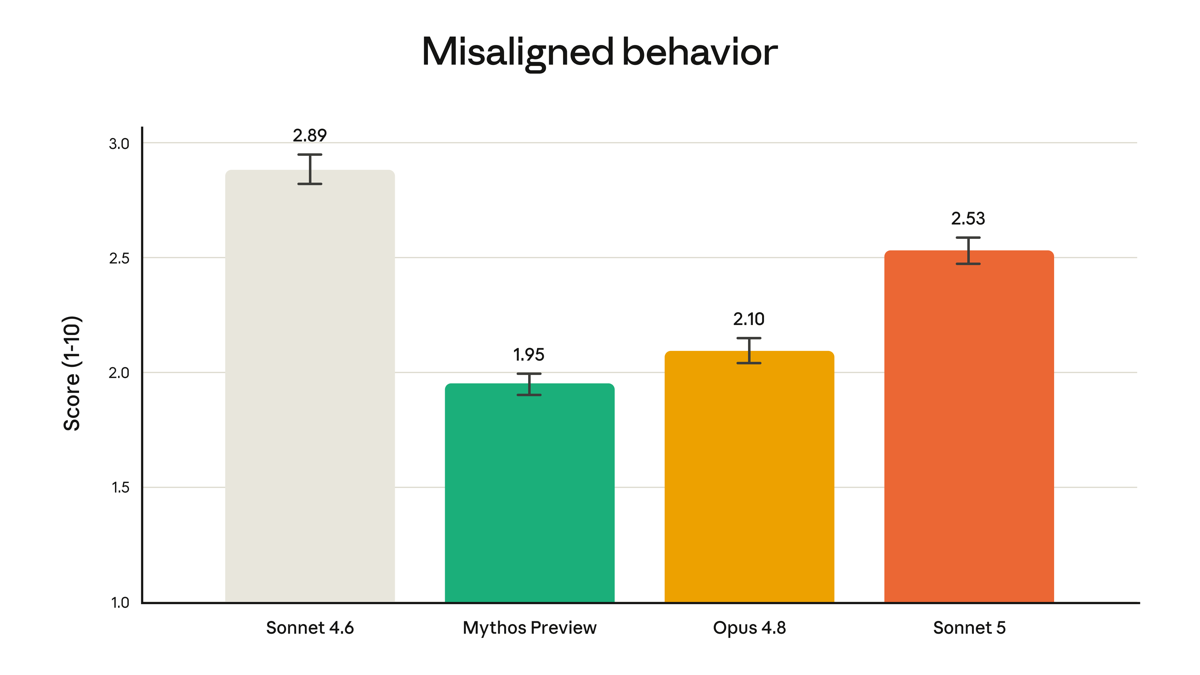
Anthropic reports Sonnet 5 scored 0% on its Firefox software-exploit evaluation (it could not develop a working exploit) and ships with cyber safeguards on by default. On the broader misaligned-behavior audit, it improved over Sonnet 4.6 but did not match Opus 4.8.
What this means if you’re building with Claude
- Default-model swaps are coming whether you opt in or not. Sonnet 5 is now the Free/Pro default, so end-user-facing apps that route to “the latest Sonnet” will move automatically. Pin
claude-sonnet-5explicitly if you need reproducibility. - Re-cost before you migrate. The token multiplier means a like-for-like switch from Sonnet 4.6 is not a free upgrade for English-heavy workloads. Run a sample batch and compare actual token counts, not list prices.
- It’s a real Opus alternative for agentic coding. If you were paying Opus rates only because Sonnet 4.6 couldn’t keep up on tool-use and terminal tasks, Sonnet 5 narrows that gap enough to retest.
- Drop unsupported params. Code that sets
temperature/top_p/top_kwill need updating before it callsclaude-sonnet-5.
Switching Claude models in your IDE or API stack? Our guide to switching to Claude Opus 4.8 covers the same dropdown and API-string mechanics — they apply identically to Sonnet 5. For the flagship comparison, see our Claude Opus 4.8 overview.
Sources
- Claude Sonnet 5 — Anthropic (official announcement, pricing, benchmarks)
- What’s new in Claude Sonnet 5 — Simon Willison (context window, tokenizer testing, API changes)
- Anthropic API — model overview (model IDs)
Source: Anthropic