Gemini 3.8 Flash is GA at the same $0.75/$3.75 — but Google now defaults managed agents to it
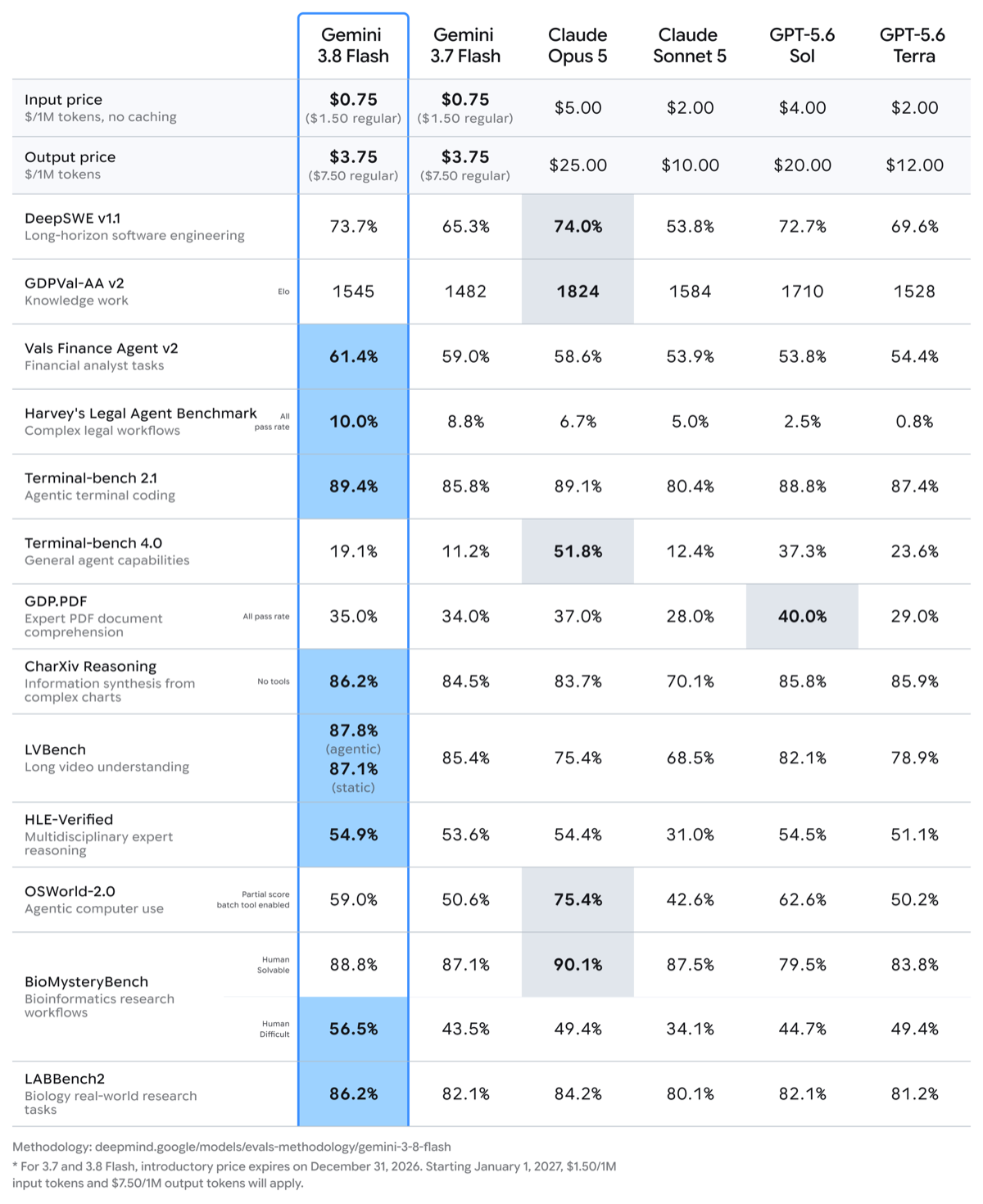
Google released Gemini 3.8 Flash (gemini-3.8-flash) on September 2, 2026. It keeps the introductory $0.75/$3.75 per-million-token rate through Dec. 31, adds low/medium/high thinking controls, and becomes the default for Gemini managed agents.
Google made Gemini 3.8 Flash generally available on September 2, 2026. Its API model ID is gemini-3.8-flash. The practical change is not just a new model option: Google’s Managed Agents and Antigravity SDK now use 3.8 Flash by default. (Source: Google Gemini API documentation, 2026-09-02)
Key facts:
- Gemini 3.8 Flash is GA and ready for production use. (Source: Google Gemini API changelog, 2026-09-02)
- Its introductory rate is $0.75 per 1M input tokens and $3.75 per 1M output tokens. That rate lasts through December 31, 2026. (Source: Google Gemini API documentation)
- Standard pricing becomes $1.50 input and $7.50 output per 1M tokens on January 1, 2027. (Source: Google Gemini API documentation)
- The model has a 1M-token context window and a 64K-token maximum output. It supports
low,medium, andhighthinking levels. (Source: Google Gemini API documentation) - Gemini 3.8 Flash Cyber is a different release. It is limited to trusted defenders through Google’s Fairwind Program. (Source: Google announcement, 2026-09-02)
What this means if you build with Gemini
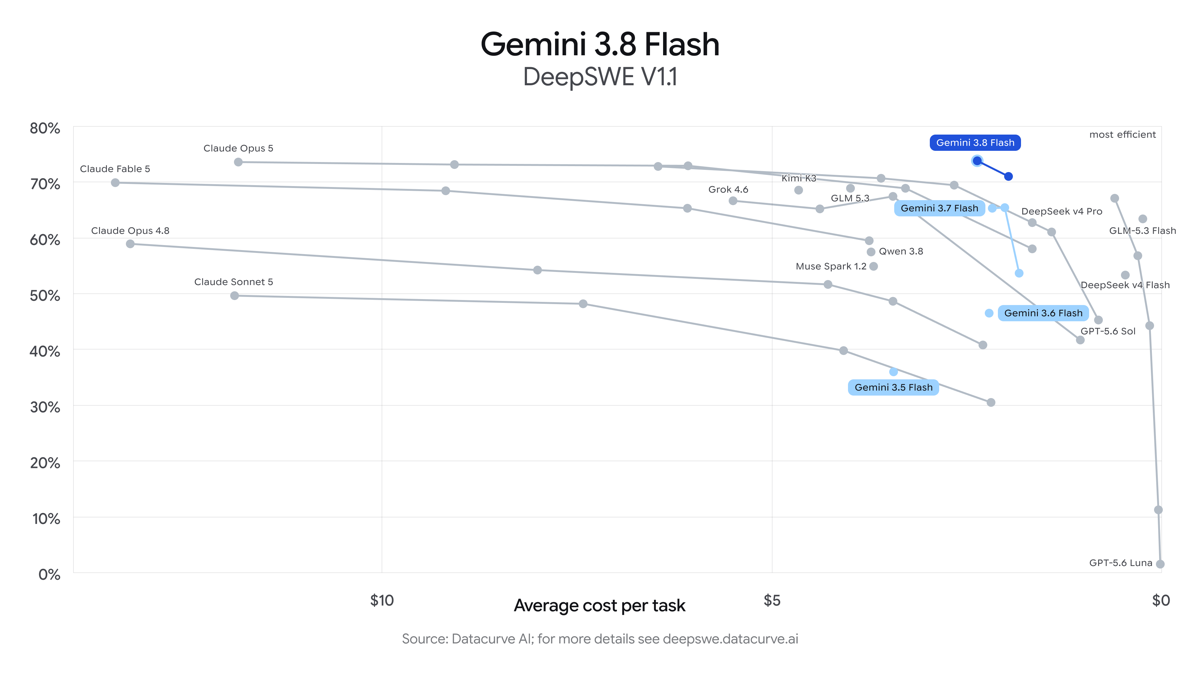
The list price is unchanged, but your effective bill may not be. Google says 3.8 performs extra reasoning steps and iterative tool calls on difficult work, especially at higher thinking levels. A $0.75/$3.75 token rate therefore does not guarantee that a long-running agent costs the same per completed task. Measure tokens, tool calls, latency, and task success together. (Source: Google announcement, 2026-09-02)
Audit managed-agent defaults before calling this a free upgrade. Google documents that the default Antigravity managed agent and Antigravity SDK now use 3.8 Flash. If a production workflow relies on a managed default rather than an explicit model setting, it can change behavior without a model-ID edit in your code. Pin the model during an A/B run; keep a baseline task set and compare completed-work cost, not a single benchmark score. (Source: Google Gemini API documentation)
Do not route cyber work to the public Flash endpoint by assumption. gemini-3.8-flash and Gemini 3.8 Flash Cyber share a foundation, but Google describes Cyber as a separately access-controlled offer for trusted defenders. Treat it as unavailable unless your organization has Fairwind access. (Source: Google Fairwind Program)
For the migration mechanics, start with our Gemini 3.6 Flash guide and compare your existing setup with Gemini 3.5 Flash. Google says 3.7 Flash remains supported for efficiency-first workloads, so retaining it as a controlled baseline is a valid option—not a failed upgrade. (Source: Google announcement, 2026-09-02)
Sources
- Google — Introducing Gemini 3.8 Flash and 3.8 Flash Cyber
- Google Gemini API — What’s new in Gemini 3.8 Flash
- Google Gemini API changelog
- Google DeepMind — Fairwind Program
Related: How to use Gemini 3.6 Flash · How to use Gemini 3.5 Flash · Gemini 3.7 Flash release
Source: Google (official blog)