Gemini 3.8 Live adds background reasoning — budget voice agents by minute, not token headline
Google released Gemini 3.8 Live and Gemini 3.8 Live Extended Thinking on September 15, 2026. The Live API model IDs are gemini-3.8-live and gemini-3.8-live-extended-thinking; paid audio is priced at $0.005 per input minute and $0.018 per output minute.
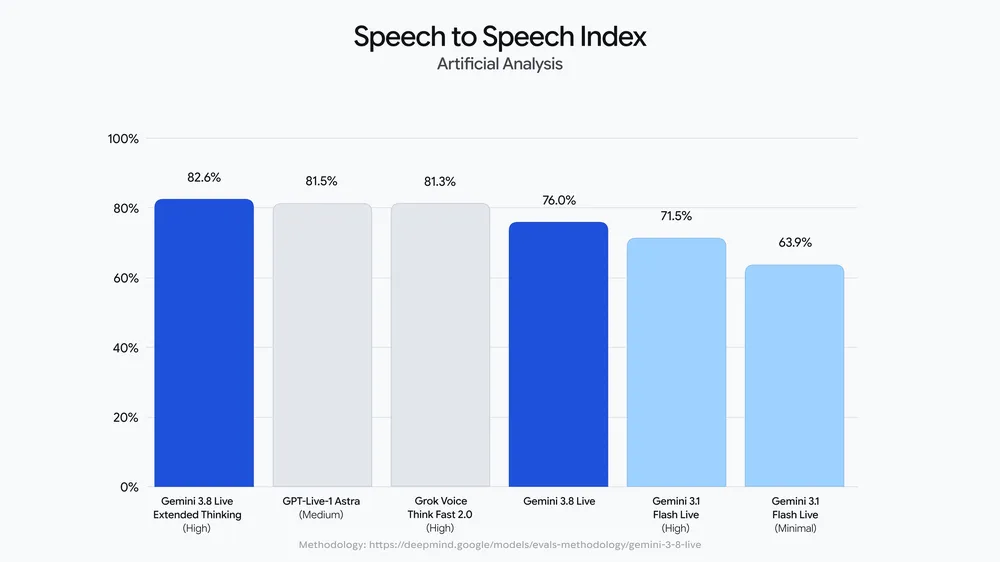
Google released Gemini 3.8 Live and Gemini 3.8 Live Extended Thinking on September 15, 2026. Both are available through the Gemini API and Google AI Studio. The distinguishing feature is that Extended Thinking can reason and run background tool work while it continues a spoken conversation. (Source: Google official announcement, 2026-09-15)
Key facts:
- The API model IDs are
gemini-3.8-liveandgemini-3.8-live-extended-thinking. (Source: Google Gemini API pricing) - Paid input audio costs $0.005 per minute. (Source: Google Gemini API pricing)
- Paid output audio costs $0.018 per minute. (Source: Google Gemini API pricing)
- The Live API uses a stateful WebSocket connection. Its audio input is 16-bit PCM at 16 kHz and its audio output is 24 kHz PCM. (Source: Gemini Live API overview)
- Google says 3.8 Live automatically switches among 97 supported languages mid-conversation. This is a vendor claim, not an independent language-quality evaluation. (Source: Google official announcement)
What this means if you build voice agents
Price the conversation, not only the model. Input plus output audio is $0.023 per minute at the listed paid rates when both streams run for a full minute. A 10-minute two-way session is therefore roughly $0.23 before text tokens, images or video, Search grounding, and any tools you operate. That makes barge-ins, silence handling, and unnecessarily long acknowledgements direct cost controls—not merely UX polish. (Source: Google Gemini API pricing)
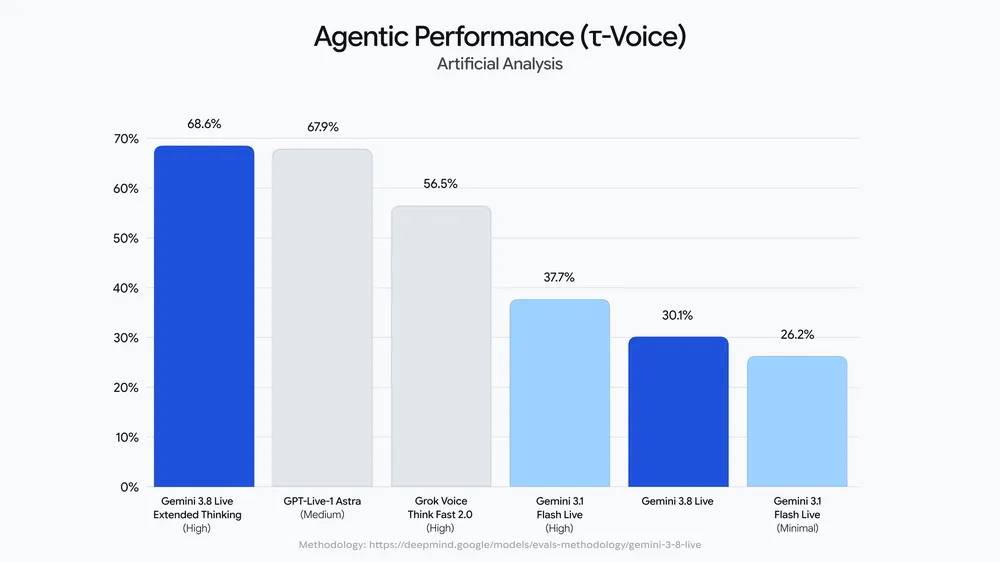
Extended Thinking changes the concurrency design. Google says the model can continue speaking while asynchronous function calls run. Do not assume that means a tool result is already available when the spoken acknowledgement finishes. Keep a per-session state machine, send an explicit completion event to the client, and make retries idempotent. The Live API documentation recommends ephemeral tokens for direct browser connections in production, rather than exposing a standard API key. (Source: Gemini Live API overview)
Keep server mediation for anything sensitive. Client-to-server streaming can reduce media-hop latency, but Google explicitly recommends ephemeral tokens for production browser clients. Put privileged tool calls, customer data joins, and durable booking actions behind your server; a low-latency WebSocket is not a reason to grant the browser broad credentials. Start with our Gemini 3.6 Flash guide for API setup, then use Gemini 3.5 Flash as a text-model baseline when voice is not required.
Sources
- Google — Introducing Gemini 3.8 Live and 3.8 Live Extended Thinking
- Google Gemini API — Live API overview
- Google Gemini API — pricing
Related: How to use Gemini 3.6 Flash · Gemini 3.5 Flash · Gemini 3.8 Flash GA
Source: Google (official blog)