Claude Opus 5 lands at the same price as Opus 4.8 — and roughly doubles its agentic coding score
Anthropic shipped Claude Opus 5 on July 24, 2026 at $5/$25 per 1M tokens — identical to Opus 4.8 — while more than doubling Opus 4.8 on Frontier-Bench agentic coding (21.1% → 43.3%). The model ID is claude-opus-5, it's live everywhere day one, and flagged cyber requests silently fall back to Opus 4.8. Here's what builders need to know.
Anthropic released Claude Opus 5 on July 24, 2026, calling it its most capable and “most thoughtful” model yet. (Source: Anthropic, 2026-07-24) For builders, the headline isn’t a benchmark — it’s the pricing. Opus 5 costs exactly what Opus 4.8 did, but posts far higher scores on the agentic-coding evals that actually decide model spend.
Key facts:
- Model ID:
claude-opus-5. It succeeds Opus 4.8. - Pricing: $5 / $25 per 1M input/output tokens — the same as Opus 4.8. (Source: Anthropic, 2026-07-24)
- A new Fast Mode runs at ~2.5× the speed for 2× the base price. (Source: Anthropic, 2026-07-24)
- Live day one across Claude.ai, Claude Code, Claude Cowork, and the Claude API.
- Two betas ship alongside it: mid-conversation tool changes and automatic model fallbacks.
The numbers that matter for agents
On Anthropic’s own comparison table, Opus 5 leads on most agentic tasks — and the gap over Opus 4.8 is largest exactly where it’s most expensive to run a weak model.
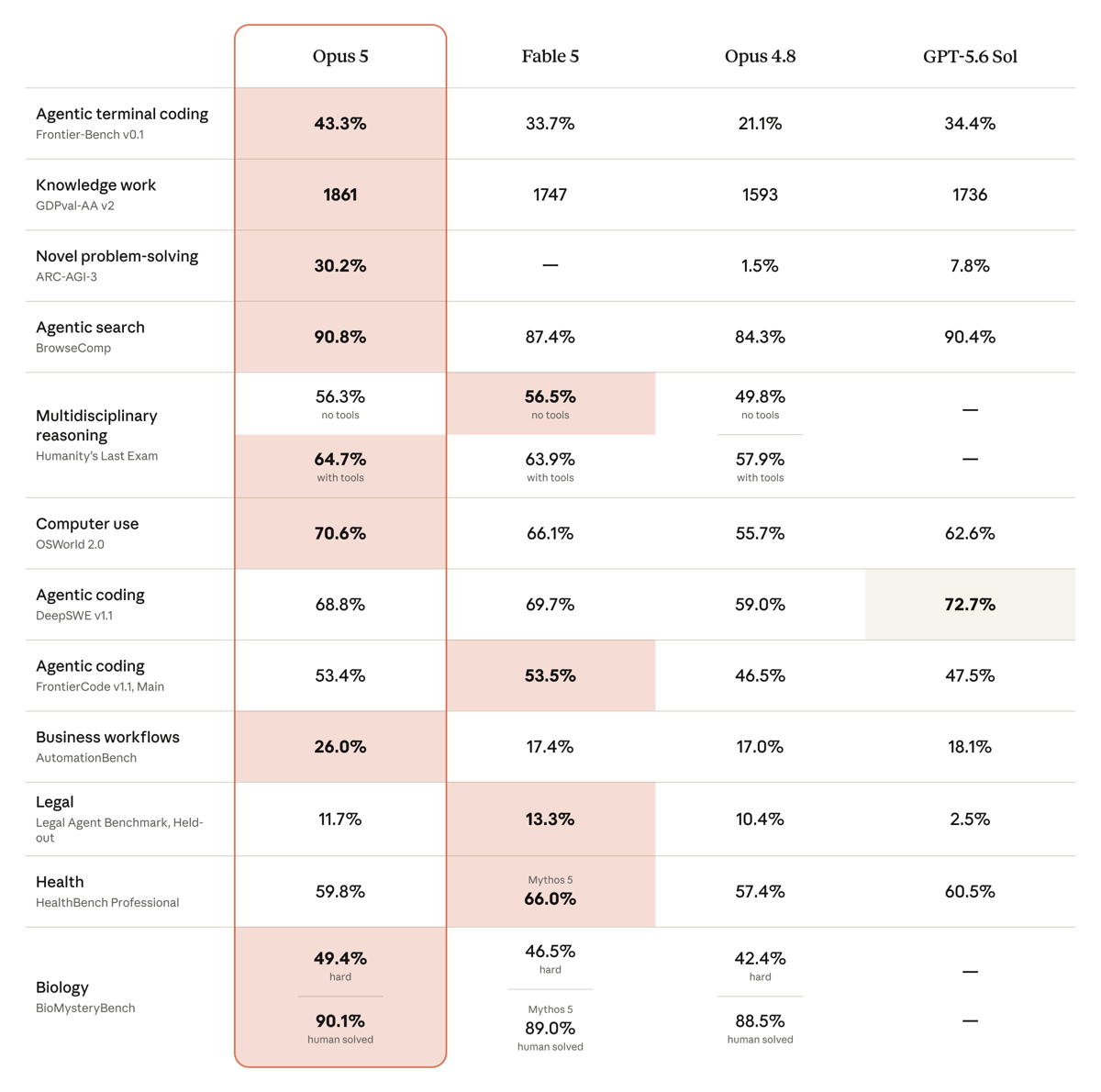
- Agentic terminal coding (Frontier-Bench v0.1): 43.3% — more than double Opus 4.8’s 21.1%, and ahead of GPT-5.6 Sol’s 34.4%.
- Computer use (OSWorld 2.0): 70.6% — versus 55.7% for Opus 4.8.
- Novel problem-solving (ARC-AGI-3): 30.2% — against Opus 4.8’s 1.5% and GPT-5.6 Sol’s 7.8%.
- Business workflows (AutomationBench): 26.0% — versus 17.0% for Opus 4.8.
- Agentic search (BrowseComp): 90.8%, edging GPT-5.6 Sol’s 90.4%.
It doesn’t win everything. GPT-5.6 Sol still leads DeepSWE v1.1 (72.7% vs Opus 5’s 68.8%), and Fable 5 stays ahead on legal and health evals. But on the terminal-agent and computer-use tasks that eat tokens, Opus 5 is clearly the value play.
Same price, better cost-per-task
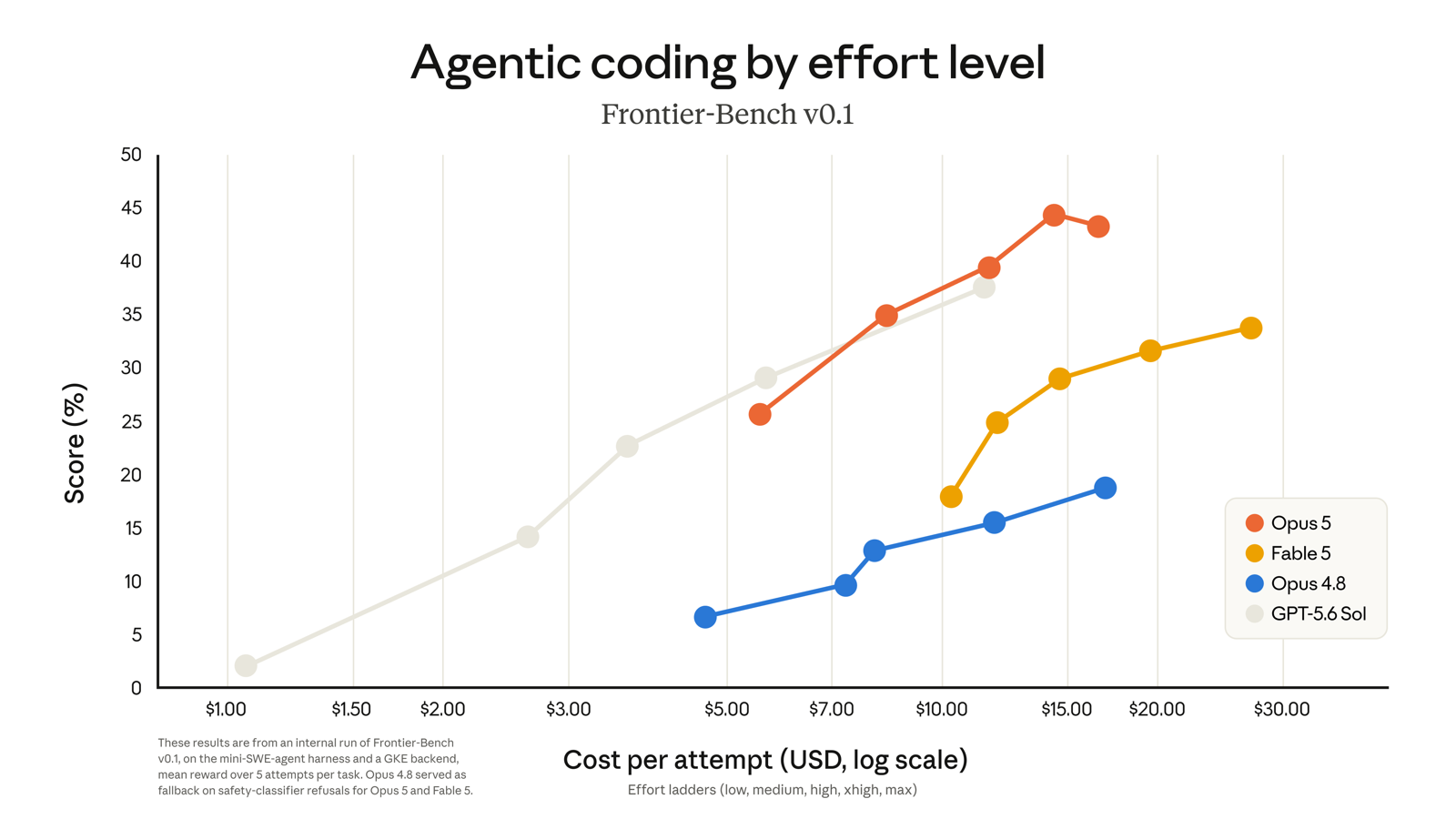
The cost curve is the real story. Because the per-token rate is unchanged from Opus 4.8, Opus 5 shifts the entire price-performance frontier up and to the left.
The fallback builders can’t ignore
Opus 5 ships with tightened cyber safeguards, and Anthropic reports its lowest-ever misaligned-behavior audit score (2.3). The practical catch: on Claude.ai, Claude Code, and Cowork, requests its cyber classifiers flag are silently routed to Opus 4.8 instead. (Source: Anthropic, 2026-07-24) If you run security-adjacent workloads — vulnerability scanning, pen-testing, exploit analysis — some calls may quietly execute on the older model. Anthropic points enterprises and researchers to its Cyber Verification Program to lift the restriction.
What this means if you’re building with Claude
- Re-cost, then upgrade — it’s rare to have an upgrade at zero rate increase. A like-for-like switch from Opus 4.8 to
claude-opus-5is a genuine free upgrade on the sticker, so retest your agent loops before assuming you need a pricier tier. - Pin the version. “Latest Opus” routing will move users onto Opus 5 automatically; set
claude-opus-5explicitly for reproducibility. - Watch Fast Mode billing. At 2× base price it’s easy to double spend without noticing — check your usage dashboard the first week.
- Test the silent fallback. Security-tooling builders should verify which of their prompts trip the classifier and land on Opus 4.8.
Switching Claude models in your IDE or API stack? Our guide to switching to Claude Opus 4.8 covers the same dropdown and API-string mechanics — they apply identically to claude-opus-5. See our Claude Opus 4.8 overview for the outgoing flagship, and the Claude Sonnet 5 release for the mid-tier option.
Sources
- Introducing Claude Opus 5 — Anthropic (official announcement, pricing, benchmarks, safety)
- Anthropic API — model overview (model IDs)
- Claude Sonnet 5 — Anthropic (prior model in the family)
Source: Anthropic