Kimi K2.7 Code is now GA in GitHub Copilot — the first open-weight model in the picker
GitHub made Moonshot AI's Kimi K2.7 Code generally available in Copilot on July 1, 2026 — the first open-weight model you can select in the Copilot model picker. It rolls out to Pro, Pro+, and Max first, is billed at provider list pricing under usage-based billing, and is off by default for Business and Enterprise. Here's what it means if you build with Copilot.
GitHub made Kimi K2.7 Code generally available in GitHub Copilot on July 1, 2026. (Source: GitHub Changelog, 2026-07-01) It is the first open-weight model you can pick from the Copilot model selector — every other option in that list, from OpenAI, Anthropic, and Google, is a closed frontier model. (Source: The Stack, 2026-07-02)
Key facts:
- It is GA, not preview. The model shows up directly in the Copilot model picker. (Source: GitHub Changelog, 2026-07-01)
- Rollout starts with Copilot Pro, Pro+, and Max, expanding to Business and Enterprise “in the coming weeks.”
- It is off by default for Business and Enterprise. A plan administrator must enable the Kimi K2.7 Code policy in Copilot settings before developers can select it.
- It is billed at provider list pricing under usage-based billing — not a flat premium request. GitHub hosts the model on Microsoft Azure. (Source: GitHub Changelog, 2026-07-01; The Stack, 2026-07-02)
- It is positioned as the low-cost option — The Stack describes it as the cheapest non-lightweight model in the picker aside from GitHub’s own Raptor mini. (Source: The Stack, 2026-07-02)
- Editor support is broad: VS Code 1.127.0+, Visual Studio 17.14.6+, JetBrains 1.9.1-251+, Xcode, Eclipse, plus Copilot CLI, the cloud agent, github.com, and GitHub Mobile.
What this means if you’re building with Copilot
The interesting part is not that a new model appeared — it’s which model. Kimi K2.7 Code is the open-weight, 1-trillion-parameter (32B active) MoE coding model Moonshot shipped on June 12, and now it is a one-click choice inside the IDE you already use, at the cheapest non-lightweight tier. For teams watching Copilot spend, that is a real lever: route routine agent turns to Kimi and reserve a frontier model for the hard ones.
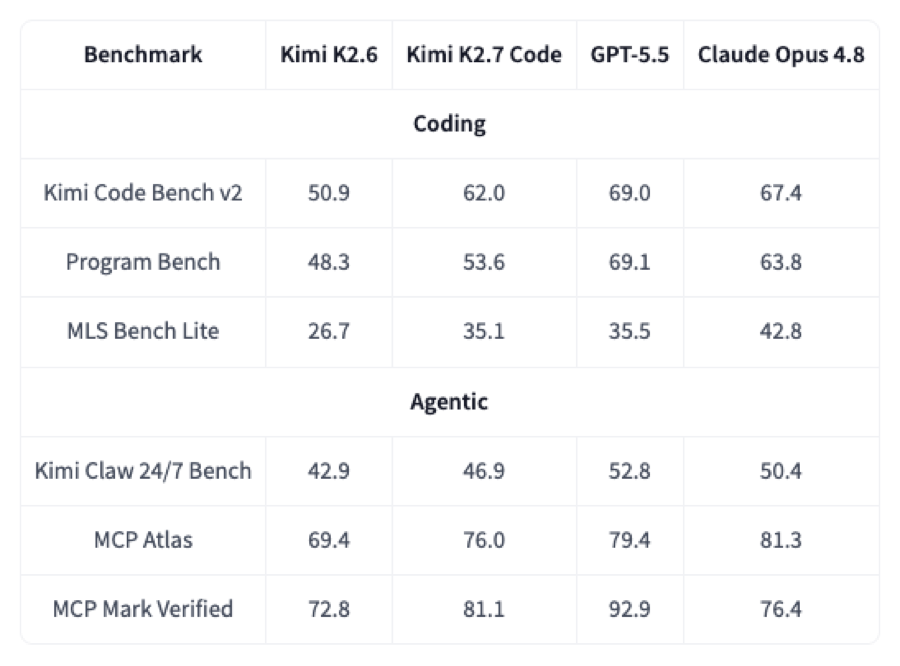
Be honest about the trade-off. On Moonshot’s own numbers, K2.7 Code trails the frontier on raw coding — 62.0 on Kimi Code Bench v2 versus 69.0 for GPT-5.5 and 67.4 for Claude Opus 4.8 — while leading Opus 4.8 on MCP-style tool use (MCP Mark Verified 81.1 vs 76.4). (Source: Moonshot AI model card, 2026-06-12) So it is a strong, cheap workhorse for tool-heavy agent loops, not a drop-in frontier replacement.
The other reason this matters: because the weights are open, the Copilot listing is not your only path. If you want to avoid usage-based billing entirely, or you need the model on an air-gapped box, you can run the same weights yourself — see our guide on how to run Kimi K2.7 Code locally. Copilot GA is the zero-setup path; self-hosting is the zero-per-token path. That “hosted convenience vs. open self-host” choice is the same one you weigh when comparing Qwen3.7-Max or DeepSeek’s Reasonix against a managed Claude Code daily driver.
One admin note worth flagging early: since it is off by default on Business and Enterprise, individual developers on those plans will not see Kimi in the picker until an admin flips the policy — so if your org wants to try it, that toggle is the first step, not a per-seat setting.
Sources
- GitHub Changelog — Kimi K2.7 Code is generally available in GitHub Copilot — official GA announcement, plans, billing, editor support, enterprise default-off policy
- The Stack — GitHub picks China’s Kimi for “low-cost” Copilot option — first open-weight model in the picker, cost positioning, Azure hosting
- Moonshot AI — Kimi K2.7 Code model card (Hugging Face) — architecture and benchmark table behind the model
Source: GitHub Changelog