Rio's 'homegrown' Rio-3.5-Open-397B turns out to be a Nex-N2 + Qwen merge
Rio de Janeiro's IplanRIO published Rio-3.5-Open-397B as an original Brazilian model. On June 14, 2026, an analysis showed its weights are a 0.6/0.4 blend of Nex-N2-Pro and Qwen3.5-397B-A17B — and the model's own card now admits the merge. Here's how the provenance was caught and why every builder should run the same checks before trusting a new model's benchmarks.
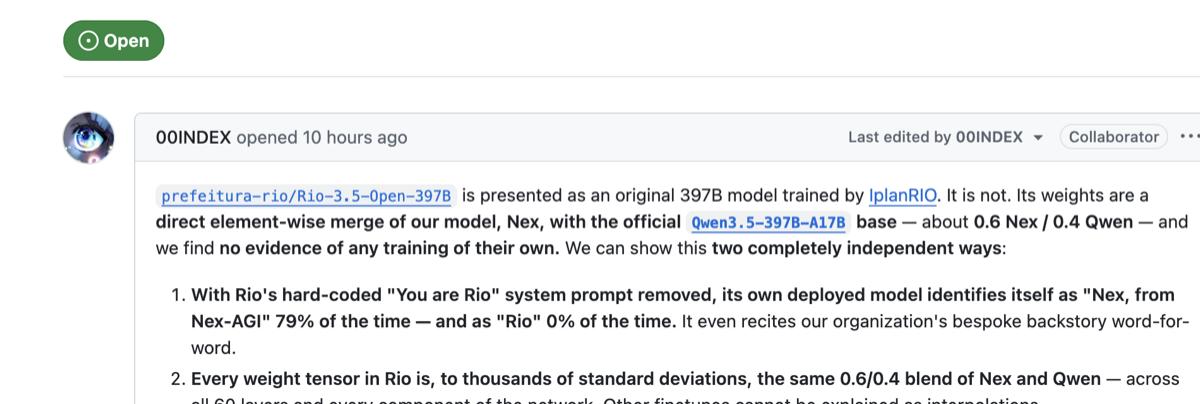
Rio de Janeiro’s city tech agency IplanRIO published Rio-3.5-Open-397B, a 397B model presented as a homegrown Brazilian LLM. On June 14, 2026, an analysis argued it was never trained from scratch — and the model’s own Hugging Face card now acknowledges it is a merge. (Source: GitHub, Nex-N2 Issue #4, 2026-06-14)
Key facts:
- The model is Rio-3.5-Open-397B, hosted at
prefeitura-rio/Rio-3.5-Open-397B. (Source: Hugging Face) - Its config lists the architecture as
qwen3_5_moe, and its model tree lists the base model asQwen/Qwen3.5-397B-A17B. (Source: Hugging Face model card) - The analysis says Rio’s weights are a direct element-wise blend of 0.6 × Nex-N2-Pro + 0.4 × Qwen3.5-397B-A17B. (Source: GitHub, Nex-N2 Issue #4)
- Nex-N2-Pro is itself a Qwen3.5-397B derivative, so the merged result is almost entirely Qwen lineage. (Source: NVIDIA Developer Forums)
- The card had 112,371 downloads in the last month before the issue surfaced. (Source: Hugging Face)
How the provenance was caught
The report uses two techniques any builder can repeat. (Source: GitHub, Nex-N2 Issue #4)
- The identity probe. Remove the model’s hard-coded “You are Rio” system prompt and ask it who it is, repeatedly. With the prompt stripped, the deployed model identified itself as “Nex, from Nex-AGI” 79% of the time and as “Rio” 0% of the time — even reciting Nex-AGI’s backstory word-for-word. A model with original post-training rarely leaks another lab’s identity this consistently.
- Weight-tensor fingerprinting. The report states that every weight tensor in Rio is the same 0.6/0.4 blend of Nex and Qwen across all 60 layers and every component, to “thousands of standard deviations.” A genuine fine-tune does not produce a clean linear interpolation of two base models.
Both sides
The Rio-3.5 team has now updated the Hugging Face card, writing that the model is “built via a merge of Nex-N2-Pro and Qwen3.5-397B-A17B, proceeded by On-Policy Distillation,” that they “detected an incorrect upload” of the pre-distillation merged version, and apologizing “profusely.” (Source: Hugging Face model card) Nex AGI’s position is that there is “no evidence of any training of their own,” while Rio says a final distilled model exists and the wrong file shipped. Independent third-party verification of that distilled version is still pending.

What this means if you build on new models
“Sovereign” and “homegrown” model launches are arriving fast, often with benchmark claims and little provenance. Before you cite a model, build on it, or quote its scores:
- Read the config and model tree first. A telling
architecturesfield (qwen3_5_moehere), a populated “Base model” link, or a “Duplicate from” note often answers the lineage question in seconds. - Run the identity probe. Strip any system prompt and ask “who are you” several times. Leaked identities are a cheap, strong signal.
- Discount benchmark claims without independent runs. A merge can inherit a strong base model’s scores while contributing nothing new — exactly the trap here.
The same caution applies whether you are evaluating an open-weight Qwen release, comparing it against Qwen 3.7 Max, weighing DeepSeek V4 Pro, or sizing up Kimi K2.7 Code: the model card is a marketing surface, and provenance is something you verify, not something you take on trust.
Sources
- Rio-3.5-Open-397B ≈ 0.6 x Nex-N2_pro + 0.4 x Qwen — Issue #4 — GitHub (nex-agi/Nex-N2), 2026-06-14
- prefeitura-rio/Rio-3.5-Open-397B model card — Hugging Face
- Analysis shows Rio de Janeiro’s Rio 3.5 Open 397B model is a weight merge — Digg, 2026-06-14
- New release: Nex-N2-Pro, a 397B parameter MoE model based on Qwen — NVIDIA Developer Forums
Source: GitHub — Nex-N2 Issue #4